Automotive & Transport
LKAB deploys 120-tonne battery-electric mining trucks from Scania at its Malmberget iron ore mine, operating over 1,250 metres below ground.
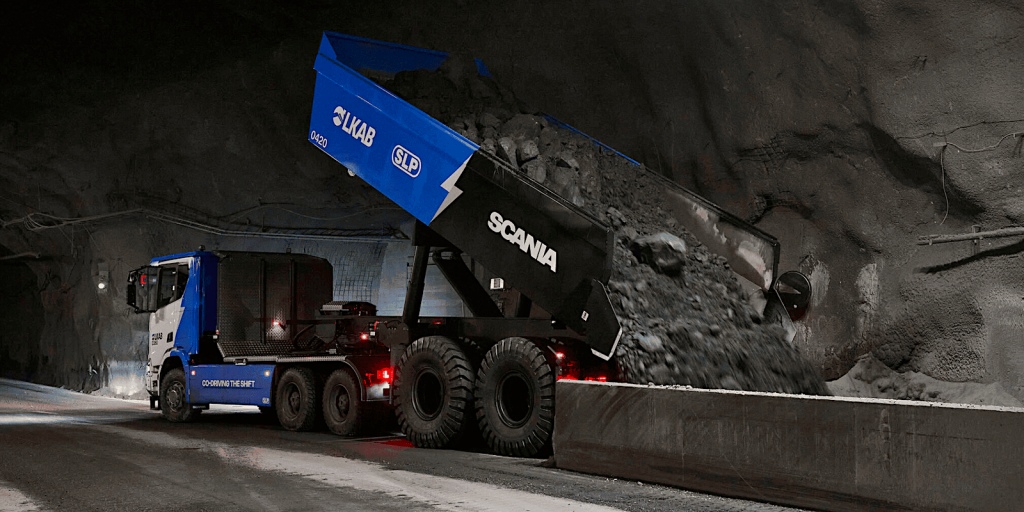
1.25km below the Swedish town of Malmberget, where iron has been mined from the ground since the 1600s, two trucks as heavy as a blue whale are carrying out a feat which would have seemed absurd a decade ago. They are operating on batteries.
The trucks belong to LKAB, Europe’s largest iron ore producer, and were built by Scania, the Swedish heavy-vehicle manufacturer. Each one is a 120-tonne, 6×4 battery-electric haulier with a 624 kWh battery pack and a payload capacity just north of 70 tonnes. Together, they have already moved more than 100,000 tonnes of iron ore without burning a drop of diesel, as reported by Electrek.
This may seem counterintuitive. In fact, a mine - with its limited tunnels and severe conditions - is one of the ideal environments for electric mining trucks. Pär Sundqvist, an electrification engineer at LKAB, gives the reason: the temperature down underground remains constantly between 12 and 15 degrees Celsius. There is no wind, no rain, and no scorching summer heat or sub-zero temperatures typical of Sweden’s winter. Batteries prefer this situation. Lithium-ion cells perform best and have the longest lifespan when they work within a narrow temperature range, and the mine supplies this condition free of charge.
The trucks are able to operate fully loaded for about seven hours per charge, which amounts to around 45 trips and the movement of approximately 3,200 tonnes of material during a shift. Charging is done at up to 375 kW using a CCS connector, the same standard as that used by electric cars, and a full top-up takes about 80 minutes.
The advantages go beyond mere efficiency. Underground mining using diesel is a unpleasant experience. Diesel engines give off nitrogen oxides, particulate matter and carbon monoxide, all of which become trapped in the enclosed tunnels with poor ventilation. In order to make the air in the mines breathable, mining companies have to spend huge amounts of money on ventilation systems. By getting rid of the combustion engines you eliminate the main source of air pollution in the underground areas and you also get rid of most of the noise. Peter Gustavsson, who is in charge of the electrification of mobile machines at LKAB, says the difference is obvious.
The electric mining trucks are not equipped with the type of e-axle drivetrain found in road-use electric lorries. Rather, Scania has fitted a central electric motor which is connected to an automated gearbox and conventional driven axles, the gear ratio being reduced in order to achieve maximum torque for the low-speed, heavy-load conditions typical of a mine. The design is modular and has been adapted from Scania’s general heavy-duty electric platform but has been customised to meet LKAB’s particular requirements.
Engineering deep dive
The engineering problems involved in designing electric mining trucks for use underground are quite different from those met when electrifying vehicles for use on roads. Instead of being limited by range or by the speed of charging as is usually the case, the constraints relate to payload fraction, thermal management in confined areas, and the structural requirements for moving rock through tunnels.
Begin with the battery; at 624 kWh, the battery pack of each truck is about six times the capacity of a large electric car. The cells used are lithium-ion and are probably of NMC (nickel manganese cobalt) chemistry since this is the type used across Scania's entire platform. It is important to consider energy density since every kilogram of battery means a kilogram that can't be used to carry ore. The fuel of a diesel truck weighs only a small part of the total payload. Because batteries are heavier, the engineering team had to find a balance between capacity and the loss of payload. The fact that the truck has a 70-tonne payload while its gross vehicle weight is 120 tonnes indicates that the battery and the drivetrain together make up a large part of the unladen mass, but the consistent operating conditions help to offset this. The battery management system is able to keep the cells close to their optimal state of charge range without extreme cold or heat cycling, thus obtaining more usable energy per cycle.
The decision to use a central motor with a mechanical gearbox rather than hub motors or e-axles is based on the operating conditions. The underground haul roads are rough, involving loose rock, water, and steep gradients. Hub motors or in-wheel drives would suffer continuously from shock and debris. A central motor, which is mounted high up and protected inside the chassis, is therefore much more durable. The automated gearbox offers a number of reduction ratios, something which is necessary since both low-speed crawling under maximum load and faster unladen return trips are required. At A-level, this illustrates the relationship between torque, speed, and power in that the gearbox exchanges rotational speed for torque at the wheels, adjusting the motor's output to match the task at each moment.
Although thermal management underground has some advantages, it also presents difficulties. The surrounding temperature is suitable for batteries, but when heavily loaded the trucks produce a large amount of waste heat through the motor and the power electronics. In a tunnel this heat has no place to go other than into the air which is already confined. Therefore the cooling system has to reject the heat efficiently without depending on the fast airflow that is used by road vehicles. Although LKAB's ventilation system provides some help, the thermal engineering of the truck itself - including the radiators, the coolant loops and the heat exchangers - had to be designed to work in conditions of low airflow.
It is within the capabilities of current DC fast-charging equipment to charge at a power rate of 375 kW using the CCS (Combined Charging System), but carrying out such charging underground introduces extra complexity. The electrical system has to provide a reliable high-power direct current supply at depth, via cabling that extends over a kilometre from the surface, and care has to be taken with power quality, cable losses, and safety in a possibly damp environment. The fact that the charging time of 80 minutes matches well with the shift schedule means that one truck can be charging while the other is working.
Regenerative braking also contributes to this effect. When the truck is going downhill along the more steep sections of the mine, the motor functions as a generator and recovers kinetic energy and feeds it back into the battery. This is the same principle as that found in regenerative braking in any electric vehicle, as described by Faraday's law of electromagnetic induction, although the scale is different. A truck weighing 120 tonnes descending a slope is able to recover a considerable amount of energy, which in turn increases the effective range per charge.
For anyone who is thinking of studying mechanical or mining engineering, this project shows that electrification is not just a matter of replacing a diesel engine with a motor; it involves rethinking the whole vehicle design, the mine's electrical setup, the maintenance procedures, and the operational logistics.
Links to the curriculum: A level, GCSE
Since 2022 LKAB and Scania have been carrying out tests with electric vehicles underground, at that time a smaller 6×4 battery-electric tipper was put through its paces at Malmberget and had covered about 50,000 kilometres before the present large-scale rollout took place. The company’s aim is to have 30% of its mining fleet running on electricity by 2027 and to extract and handle at least five million tonnes of material each year without producing any local emissions. Scania is at the same time working on a larger 80-tonne 8×4 electric hauler known as Sleipner. The shift from diesel to battery power underground is speeding up, and engineering work has shown that the most heavily used and most polluting vehicles on earth can be made cleaner without having to compromise the great strength required for the job.
Credit via electrek.co
Automotive & Transport
Automotive & TransportBreakthroughs
Automotive & Transport
Automotive & Transport