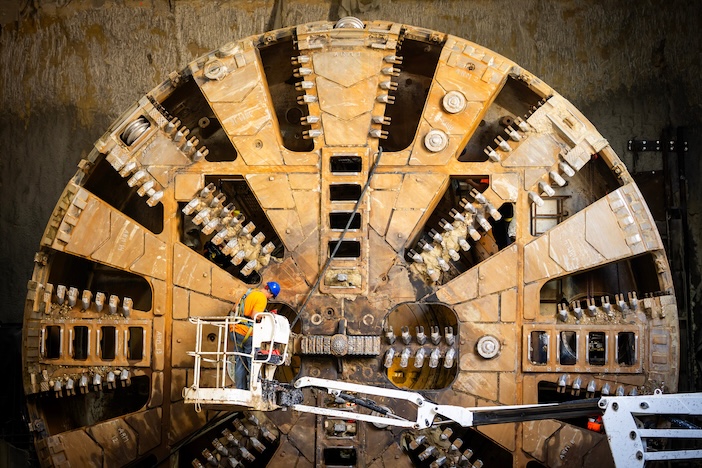
Construction & InfrastructureInnovation
How Jones Bros used 66,500 tonnes of Welsh rock armour to build the Kinmel Bay coastal defence, protecting 2,000+ homes from the sea.
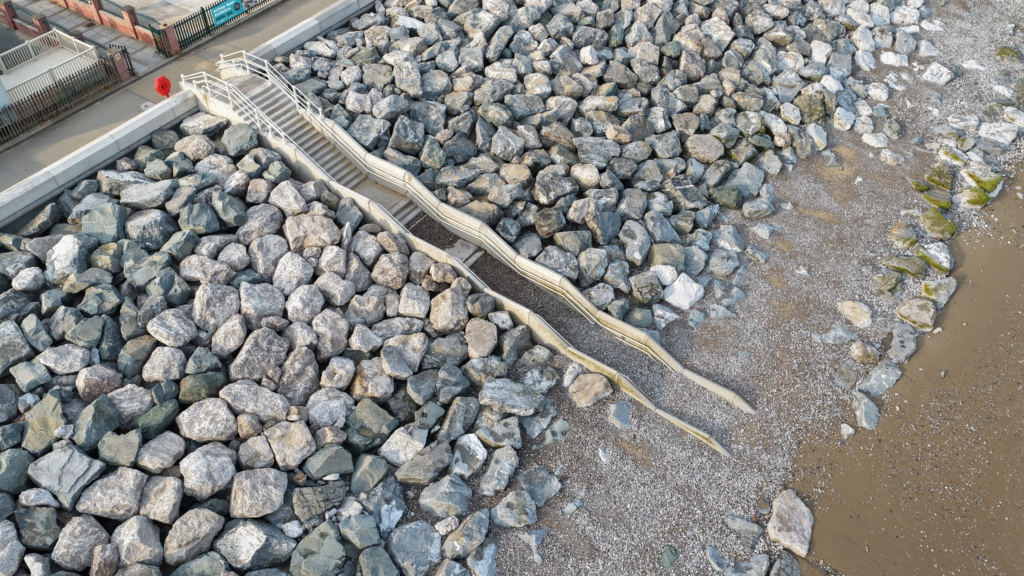
Towyn has a memory of the situation when the sea triumphs. Back in February 1990 a storm broke through the town’s coastal defences and flooded thousands of houses over night, making it one of the most severe coastal flooding incidents in modern Welsh history. Now, more than three decades on, at a place a few miles along that same part of the North Wales coast, the Kinmel Bay coastal defence scheme has been finished: engineers have piled nearly 66,500 tonnes of rock against the sea to ensure that it won’t happen again.
Jones Bros Civil Engineering, a family-owned firm based in Ruthin, completed the £15 million scheme for Conwy County Borough Council in August 2026, reinforcing 2 kilometres of coastal revetment between Towyn and Kinmel Bay. Of that rock armour, 96 per cent came from quarries within the region, a detail the project team highlighted as both a cost-saving measure and a way of keeping the scheme’s economic benefits local. According to Jones Bros’ own account of the project, the work protects more than 2,000 residential and commercial properties from flood risk.
The team also increased the existing sea wall by 560 to 750 millimetres using precast concrete units, a seemingly small rise that in fact makes a significant difference to the amount of water required for a storm surge to overflow the barrier. Both of the floodgates, which are weak spots in any sea defence should they fail during a storm, were completely replaced. As part of the 12-month construction programme, eight new stepped and ramped beach access points with handrails were installed, along with improvements to a car park and two seafront parklets.
What is clear is the way in which the project was carried out: half of the beach remained open to the public during the construction period, and access along the promenade was kept up for the entire duration of the one-year building process except for one week, a limitation that caused the contractors to plan the placement of the rock and the construction of the wall around a beach that was still open to tourists rather than closing the whole site. Sam Roberts, the project manager with Jones Bros and a man who supervised a team of as many as 60 people on site, said that working with the council to carry out the scheme had been "fantastic", pointing out that obtaining the rock armour from five quarries in the region had allowed the company to "use local suppliers where possible".
Rock armour revetments are still one of the most common methods of protecting a coastline since, unlike a smooth vertical sea wall, a jumbled stack of large rock fragments disperses and takes in wave energy over a rugged and porous surface instead of reflecting it directly back out to sea. Cllr Mike Priestley, the Cabinet Member for Environment, Roads and Infrastructure with the Conwy County Borough Council, stated that the funding obtained from the Welsh Government had resulted in “stronger coastal defences” and had at the same time improved facilities such as access to the beach and cycle facilities for both residents and visitors.
Engineering deep dive
A sea wall and a rock armour revetment achieve the same aim, namely keeping storm waves from reaching the land, but do so by means that are almost the opposite of each other. The sea wall, which is vertical or nearly vertical, reflects the energy of the waves, sending the incoming waves back out to sea. This method does work, but the waves that are reflected can gradually erode the seabed at the base of the wall and thus weaken its foundations, and when a wave strikes a hard vertical surface it can throw up a large amount of spray and even solid water high into the air and over the top of the wall during a storm surge. In contrast, rock armour works in a different way: rather than using a smooth barrier, engineers construct a rough, sloped and highly porous structure from large rock pieces, each of which often weighs several tonnes, so that the waves are able to run up through and between the rocks, their energy being dissipated by turbulence and friction rather than being reflected.
This physics is directly related to A-level mechanics and the concept of momentum. Since the energy carried by a wave is proportional to the square of its speed and to its mass, that energy must be accounted for when the wave comes up against a barrier. If the wave is reflected, as a sea wall does, the energy is conserved and is sent back out where it can interact with incoming waves and thus increase turbulence in the area. Alternatively, if the energy is dissipated, as in the case of rock armour, the kinetic energy is transformed into heat and sound by means of numerous small collisions and friction as the water forces its way through the gaps between the rocks; this is a much softer method of getting rid of the same amount of energy. This is the same principle that explains why a padded surface absorbs an impact more comfortably than a rigid one, but on a much larger scale.
The size of the rock armour is determined by formulae, most often a form of the Hudson or Van der Meer equations, these relating the mass of each individual unit of armour to the design wave height that the structure has to resist. The greater the design wave, the larger and heavier the rock must be, since a wave which is capable of moving a rock will ultimately dislodge it from the revetment and thus create a gap which the following wave can take advantage of and enlarge. This is one of the reasons why the total weight at Kinmel Bay - amounting to nearly 66,500 tonnes over a length of 2 kilometres - is a significant engineering figure rather than merely an impressive-sounding one: it shows the result of a specific calculation concerning the mass of rock and its size distribution that is required in order to survive the storm conditions which the coastline can expect throughout the structure's design life.
Increasing the sea wall by 560 to 750 millimetres deals with a related but distinct issue: overtopping, which occurs when wave run-up or a storm surge simply flows over the top of a sea defence that is otherwise intact. In order to assess the risk of overtopping, engineers use formulae for wave run-up that take into account the height of the waves, the slope of the wall and the freeboard, that is, the vertical distance between the normal water level and the top of the wall. A few hundred millimetres more freeboard can make a significant difference to the amount of water that overtops the wall during a particular storm, which is the reason why relatively unimpressive wall raises such as this one can have a meaningful impact on a community's flood risk.
Kinmel Bay is a useful example for students studying civil and environmental engineering in showing how modern coastal schemes manage conflicting requirements - namely, ensuring structural performance in the face of storm loads, taking into account environmental and amenity factors such as keeping beach access open, and dealing with the logistics of carrying out construction in phases around an actively used public area and the tourist season. The fact that 96 per cent of the rock armour is sourced from the local area also illustrates the wider trend in UK infrastructure towards lowering embodied carbon resulting from transport, as transporting tens of thousands of tonnes of rock over long distances by road has its own carbon and cost implications.
Links to the curriculum: A level, GCSE
The new coastal defence at Kinmel Bay will have to be put to the test by winter storms, just as all coastal engineering ultimately does, rather than by referring to the design drawings. Since climate projections indicate that the Welsh coast will experience more frequent and severe surge events in the coming decades, making the current decision to increase the height of the wall - to do so now rather than having to wait for the next near-miss - appears to be sound engineering rather than simply acting with caution. For a community that has already witnessed the effects of an unprotected coastline, the use of 66,500 tonnes of rock represents a significant and locally obtained form of insurance.
Credit via jones-bros.com
Construction & InfrastructureInnovation
Construction & Infrastructure
Construction & InfrastructureInnovation
Construction & Infrastructure