Aerospace, Defence & MarineInnovation
Rocket Lab's flatellite satellite design won a $397 million US Space Force contract for a flat, stackable satellite constellation.
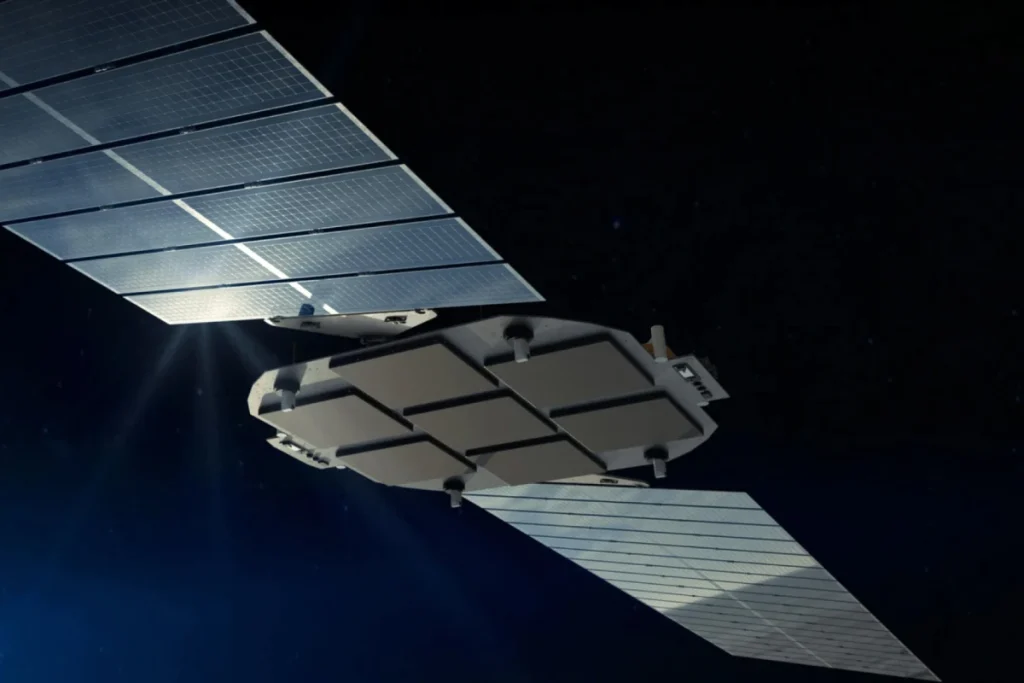
The Space Force of the United States has given Rocket Lab a contract worth $397 million for the construction of what it terms flatellites, a kind of flat satellite which is intended to be made in hundreds rather than one at a time.
The satellite known as the flatellite, which has been developed by Rocket Lab, is taking part in the Space-Based Airborne Moving Target Indicator programme or SB-AMTI, the aim of which is to keep an eye on moving targets whether they are on the ground or in the air from orbit by using a large number of satellites working together rather than depending on a small number of expensive, individually built spacecraft.
The way in which a flatellite differs from a conventional satellite is that it has a flat shape. Rather than having the boxy and appendage-filled structure which is typical of most spacecraft, a flatellite incorporates all the equipment-such as the propulsion system, the avionics, the reaction wheels, the star trackers, the solar arrays, the radios, and the fuel tanks-into one flat and low-profile frame.
It isn’t just a matter of design choice for this flat shape; it is included in the way the satellites are manufactured and launched. Flat satellites can be stacked one upon another in the rocket’s payload fairing, just as plates are stored in a cupboard, so that a single launch can carry a far greater number of spacecraft than a conventional design of the same total mass could, since irregular shapes waste space and require custom mounting hardware between each unit.
Rocket Lab intends to use its Neutron rocket-the one it is currently developing-a vehicle 43 metres high and designed to carry payloads of up to 13 tonnes while at the same time being partially reusable-unlike the small, expendable Electron rocket which had earlier established the company’s reputation. The fact that Rocket Lab is combining a specially designed flat satellite with a specially designed medium-lift, reusable rocket is deliberate: the company believes that by having control over both the design of the spacecraft and that of the launch vehicle it will be able to provide competitors with a lower cost for the construction and deployment of large satellite constellations.
As New Atlas has reported, Rocket Lab’s award is only one element of a much bigger initiative; the entire SB-AMTI programme is worth $615 million and is shared out among three contractors, whereas SpaceX has a contract for a similar mission amounting to $4.16 billion - a figure which is much larger than that given to Rocket Lab and thus shows off SpaceX’s present scale in the manufacture of satellites due to its Starlink constellation. When compared with SpaceX, Rocket Lab is a far smaller company, and so securing a share of a military constellation programme against a company of SpaceX’s size is a major validation of its flatellite concept even though there is a big difference between the two contract values.
Programmes like SB-AMTI depend on having a sufficient number of satellites in orbit at the same time so as to maintain continuous tracking of moving targets rather than just obtaining short sightings when a single satellite passes over; it is for this reason that, for this kind of mission, manufacturability is just as important as capability. A satellite that takes months to hand-build might be more capable individually, but a constellation needs dozens or hundreds of satellites working in unison, and therefore a design that can be quickly and cheaply assembled and then efficiently stacked for launch turns out to be more important to the mission than the individual specifications of any one spacecraft. This is the gap which the Rocket Lab flatellite satellite design is intended to close by considering a satellite not as a custom-made instrument but as a mass-produced component.
If you want to keep a continuous watch on moving targets from orbit, you have to cope with a basic problem in orbital mechanics: a single satellite in low Earth orbit only remains over any given point on the ground for a short period of time - typically just a few minutes - because it must travel at around 7.8 kilometres per second in order to remain in a stable orbit against the attraction of Earth’s gravity, a fact which is explained in A-level physics under the section on circular motion and gravitational fields.
To make sure that an area is constantly covered, it is necessary to have a sufficient number of satellites in orbits suitable for the task so that when one satellite goes out of sight another takes over and assumes its place. It is this requirement which leads programmes such as SB-AMTI to choose large constellations consisting of a great many small and relatively simple satellites rather than a small number of large and extremely capable ones, since the degree of coverage depends just as much on the number of satellites and the way in which their orbits are arranged as it does on the quality of each individual satellite’s sensor.
The engineering required when designing a satellite for mass production is entirely different from that needed when designing one with the aim of achieving the highest possible individual performance.
Traditional satellites are generally built on a central bus, with the solar panels, antennas, and instruments added as separate parts, each of which needs its own mounting fittings, wiring harnesses, and a separate structural analysis to make sure it can endure the vibrations during launch. With a flatellite, on the other hand, the propulsion system, the avionics, the reaction wheels, the star trackers, the radios, and the fuel tanks are all built directly into one single flat structural frame, which in turn reduces the number of separate components, connections, and structural interfaces that have to be designed, tested, and assembled individually. Since there are fewer different parts and the assembly process is simpler, production can be carried out more quickly and at a lower cost, a factor that is particularly important when the objective is to build dozens or hundreds of satellites rather than just one or two.
The fact that the satellite has a flat shape also deals with a specific problem in the design of rocket payloads: fairing volume. The amount of space available in the nose cone of a rocket is fixed, and conventional satellites, with their solar panels, antennas and other projecting components, generally make inefficient use of that space, which means that there are always some unused gaps on each launch.
Since flat satellites can be stacked with only small gaps between them, just as flat-pack furniture is more efficiently shipped than assembled furniture, a single Neutron launch could carry a significantly larger number of flatellites than the same fairing volume would be able to hold if it contained traditionally shaped satellites. For a project of the scale of a constellation, this packing efficiency directly cuts down the number of launches needed to obtain full operational coverage, which is one of the principal cost factors involved in setting up and keeping any large satellite network.
You won’t get any advantages from this setup unless you make certain concessions. A flat and thin design is less naturally rigid than a more boxy one, and as a result of so many subsystems being built into a single common frame, thermal management becomes more difficult because flat satellites lack the natural separation that enables the heat-generating components on a conventional bus to radiate into space independently of each other. The fact that the reaction wheels, the radios, and the avionics all give off waste heat means that, since they are all placed in this shared flat structure, the engineers have to carefully examine where the heat will collect and guide it to the radiating surfaces, so that it doesn’t build up close to the sensitive electronics.
Rocket Lab’s approach appears to view these problems as constraints which can be dealt with so as to benefit from the savings in both launch and manufacturing that are obtained from the flat design, choosing the cost and schedule benefits of mass production rather than carrying out the additional thermal and structural engineering work needed to ensure that the flat satellite operates reliably in orbit.
For anyone with an interest in aerospace engineering, the flatellite serves as a useful example of the types of systems-level trade-offs that are rarely found in textbook physics problems; instead of merely or even mainly focusing on maximising the performance of any one subsystem, the decision regarding a satellite’s shape involves optimising the entire process from the factory floor to orbital coverage.
The reason why a constellation has to comprise many satellites is explained by circular motion and orbital mechanics, but it is manufacturing engineering and payload fairing geometry which have caused a flat design - rather than a more usual satellite bus - to win a defence contract amounting to almost $400 million. This shows that engineering decisions in the aerospace industry are just as affected by production lines and rocket geometry as they are by orbital physics.
It is not expected that Rocket Lab will launch its flatellites until the Neutron rocket is ready, and since the Neutron rocket has not yet carried out an orbital flight, the exact timeline for deploying the flatellites still depends on a vehicle which is at present only in the testing and development phase. If the Neutron rocket succeeds in its flight and if the flatellite design turns out to be capable of being scaled up as Rocket Lab wants it to be, the SB-AMTI programme would allow the US military to keep continuous watch over moving targets over large areas, a capability which is at the present time limited by the small number of satellites that can be built and launched quickly enough to maintain it. Currently, the $397 million award is just as much a bet on the Rocket Lab flatellite satellite design as it is on the rocket that will take it into orbit.
Credit via newatlas.com
Aerospace, Defence & MarineInnovation

Aerospace, Defence & Marine

Aerospace, Defence & Marine