
Energy & EnvironmentBreakthroughs
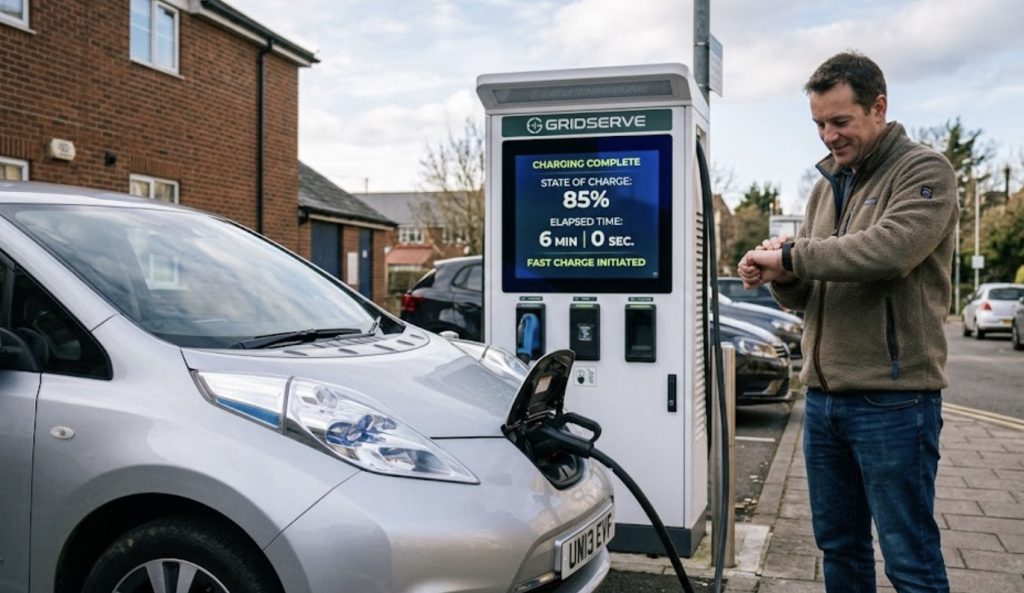
A fast charging EV battery from Adelaide and Imperial College reaches 85% charge in six minutes with 240 Wh/kg energy density and 76% retention after 500 cycles.
The question that haunts every electric vehicle engineer is not whether batteries can store enough energy.
Modern cells already manage that tolerably well. The question is how fast you can put that energy back in. A team led by Prof Shi-Zhang Qiao at the University of Adelaide, working with collaborators at Imperial College London, has built a fast-charging EV battery that reaches 85% state of charge in six minutes flat. Give it ten minutes, and it hits 91.4%. The work, published in Nature Energy, does not rely on exotic new chemistries or materials that exist only in milligram quantities. It uses silicon anodes, a technology the battery industry has been trying to tame for years, and solves the speed problem at the surface.
Screenshot
The cells deliver an energy density of 240.4 watt-hours per kilogram, which is competitive with the best commercial lithium-ion cells on the market today. After 500 cycles of six-minute fast charging, they retain 76% of their original capacity. The average coulombic efficiency across those cycles is roughly 99.94%, meaning almost every lithium ion that leaves the cathode during discharge returns during charge. These are not laboratory curiosities. These are numbers that automotive battery engineers can work with.
Silicon is, on paper, the ideal anode material for lithium-ion batteries. It can absorb roughly 10 times as much lithium per unit mass as the graphite anodes used in virtually every commercial cell. That translates directly into higher energy density. The problem is that silicon swells by up to 300% when it absorbs lithium and contracts again when it releases it. This repeated expansion and contraction cracks the electrode, exposes fresh silicon surfaces to the electrolyte, and triggers the formation of new solid electrolyte interphase (SEI) layers that consume lithium and electrolyte with every cycle.
Fast charging makes this worse. PRapidly pushing lithium ions into the anode creates concentration gradients that amplify mechanical stress and accelerate SEI breakdown. Most silicon anode research has focused on managing the mechanical problem through nanostructuring, binders, or coatings. Qiao’s group took a different approach. They went after the SEI itself.
The team engineered the electrode surface with sulfur vacancies, deliberate gaps in a sulfur-containing compound that act as catalytic sites. These vacancies attract anions from the electrolyte, specifically fluorine-containing species, and promote the formation of an SEI layer that is rich in lithium fluoride (LiF). Lithium fluoride is mechanically hard, chemically stable, and, importantly, allows lithium ions to pass through it quickly. A LiF-rich SEI does not crack and reform the way a conventional organic SEI does. It holds together during volume changes and provides fast ion-transport pathways even under aggressive charging conditions.
There are, naturally, gaps between a published paper and a production cell. The team’s results come from coin cells and pouch cells tested under controlled laboratory conditions. Scaling to the large-format prismatic or cylindrical cells used in vehicles introduces challenges in thermal management, electrode coating uniformity, and electrolyte distribution. The sulfur vacancy approach adds a processing step to electrode manufacturing that would need to be validated at production volumes and speeds. None of these is insurmountable, but they represent real engineering work that will take time.
Prof Qiao, an ARC Industry Laureate Fellow in Adelaide’s School of Chemical Engineering, has a track record of moving electrode research toward practical application. The collaboration with Imperial College London adds expertise in electrochemical characterisation and cell design. Whether this particular chemistry reaches production will depend on how it performs in larger cells and whether battery manufacturers see a cost advantage over competing fast-charging approaches, several of which are also advancing rapidly.
Engineering deep dive
The solid electrolyte interphase is a thin film that forms on the anode surface during the first few charge cycles of a lithium-ion battery. It is created by the decomposition of electrolyte molecules at the low potentials present at the anode. In a well-functioning cell, the SEI stabilises after formation and acts as a passive barrier that allows lithium ions to pass through while blocking electrons and solvent molecules. In a poorly functioning cell, the SEI continues to grow, consuming electrolyte and lithium, increasing the cell's internal resistance, and eventually killing it.
On graphite anodes, SEI management is well understood. The volume change during lithiation is modest (about 10%), so the SEI remains largely intact from cycle to cycle. On silicon, the 300% volume change tears the SEI apart with every cycle, exposing fresh surface to the electrolyte and triggering new SEI formation. This is the primary reason silicon anodes degrade quickly, and it is the problem that the Adelaide team's approach directly addresses.
Lithium fluoride is a key component of high-performance SEI layers. Its crystal structure has a high shear modulus, meaning it resists mechanical deformation. It is also an excellent lithium-ion conductor in thin-film form, with ionic conductivity several orders of magnitude higher than the organic polymers that dominate conventional SEI layers. An SEI rich in LiF is therefore both mechanically robust and electrochemically functional, the two properties most needed on a silicon anode undergoing fast charging.
The sulfur vacancy strategy works by biasing the surface chemistry toward LiF formation. Sulfur vacancies are point defects in a sulfur-containing surface layer (typically a metal sulfide) where sulfur atoms are missing from the crystal lattice. These vacancies carry a local positive charge that attracts negatively charged fluorine-containing anions from the electrolyte, such as hexafluorophosphate (PF₆⁻) or bis(trifluoromethane-sulfonyl)imide (TFSI⁻). By concentrating these anions near the electrode surface, the vacancies ensure that when the SEI forms, it incorporates a high proportion of fluorine, which reacts with lithium to produce LiF.
The elegance of this approach is that it works within the existing electrochemical window of standard electrolytes. There is no need for exotic electrolyte formulations or additional coatings. The sulfur vacancies are engineered into the electrode during manufacturing, and the beneficial SEI forms naturally during the first charge cycles. This self-assembling character is attractive for manufacturing scale-up because it avoids the need for additional processing steps during cell assembly.
From a transport perspective, the LiF-rich SEI provides fast lithium-ion pathways because LiF grain boundaries offer low-energy migration routes for Li⁺ ions. In a nanocrystalline LiF film, the high density of grain boundaries creates a percolating network of fast-transport channels. This is why the team's cells can accept charge so quickly: the ions do not have to fight through a thick, resistive organic layer to reach the silicon surface. They pass through a thin, conductive inorganic film that stays intact even as the silicon beneath it expands and contracts.
Links to the curriculum: A level
Six minutes to 85% would transform the refuelling experience for electric vehicles. It would not quite match the speed of filling a petrol tank, but it would come close enough to eliminate range anxiety for most drivers. The Adelaide and Imperial College team have shown that the physics allows it. The engineering challenge now is to show that manufacturing allows it at a scale of millions of cells per year and at a cost of a few tens of pounds per kilowatt-hour. That is a different kind of problem, but one that the battery industry has solved before.
Credit via adelaide.edu.au
Energy & EnvironmentBreakthroughs

Electronics & CommunicationsBreakthroughs

Energy & EnvironmentInnovation