Energy & EnvironmentBreakthroughs
The UK has appointed ILIOS consortium to build its first fusion energy plant at West Burton, advancing the STEP programme toward a working prototype by 2040.
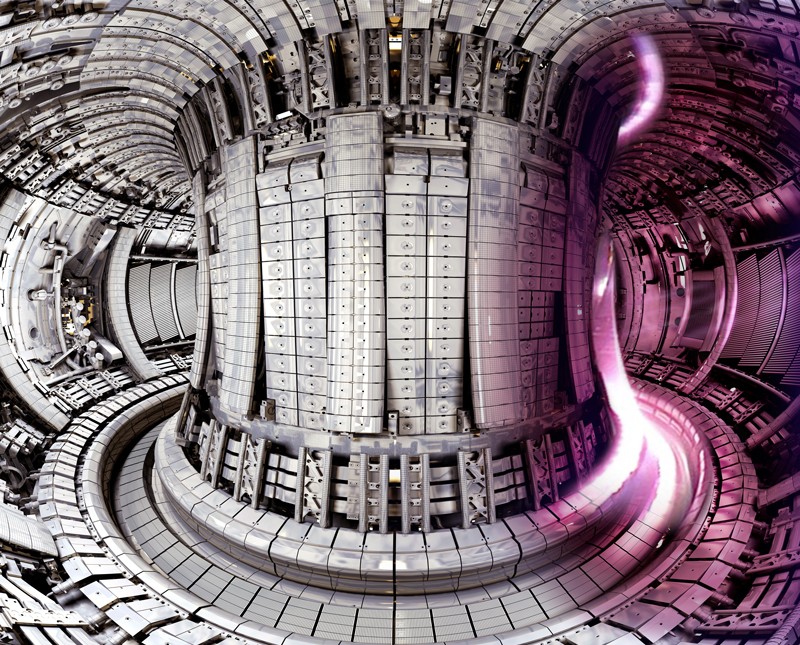
The ILIOS consortium, led by Kier and Nuvia, has won the £200m contract to build the UK's first prototype fusion energy plant at West Burton in Nottinghamshire.
The STEP (Spherical Tokamak for Energy Production) programme aims for a working prototype by 2040, using a compact spherical tokamak design.
At peak construction, the project will support up to 8,000 jobs, transforming a former coal power station that closed in 2023.
Success would deliver effectively limitless, zero-carbon energy with no long-lived radioactive waste.
A former coal-fired power station in Nottinghamshire is about to become the construction site for something that has never been built before: a prototype fusion energy plant designed to generate electricity for the grid. The UK government announced this month that the ILIOS consortium, led by Kier Group and nuclear specialist Nuvia, has won the £200 million contract to serve as principal construction partner for the Spherical Tokamak for Energy Production, known as STEP. The Construction Enquirer reported that ILIOS beat bids from two other heavyweight consortiums to land the deal.
West Burton Power Station closed in 2023 after 57 years of generating electricity from coal. Its transformation into a UK fusion energy plant is intended to demonstrate that fusion, the process that powers the sun, can be harnessed to produce commercial electricity here on Earth. Paul Methven, CEO of UK Fusion Energy, described the appointment as the moment the programme moves from research to delivery.
The STEP programme aims to have a working prototype by 2040. That might sound a long way off, but the engineering challenges are formidable. No one has yet built a fusion reactor that produces more energy than it consumes over a sustained period, although the National Ignition Facility in California achieved a single burst of net energy gain in 2022. STEP’s ambition is different: continuous, reliable power generation.
ILIOS will oversee all early enabling works, civil engineering, buildings, and site infrastructure. The consortium includes AL_A Architects, Aecom, and Turner & Townsend alongside Kier and Nuvia. At peak construction, the project is expected to support up to 8,000 jobs on site, a significant economic boost for the East Midlands. The initial contract runs to 2029 with options for extension.
The project sits within a broader UK fusion strategy that includes a March 2029 deadline for submitting the Development Consent Order application. Alongside STEP, the government’s Modern Industrial Strategy has committed £2 billion to quantum computing and signalled sustained investment in other deep technology sectors. Fusion, though, occupies a unique position: success would mean an effectively limitless, zero-carbon energy source with no long-lived radioactive waste.
Engineering deep dive
Fusion is the opposite of nuclear fission, which powers existing nuclear plants. Fission splits heavy atoms (typically uranium) into lighter ones, releasing energy. Fusion forces light atoms together to form heavier ones, also releasing energy, but on a far greater scale per unit of fuel. The most promising fuel combination is deuterium and tritium, both isotopes of hydrogen. When these fuse, they produce helium, a neutron, and approximately 17.6 million electronvolts of energy per reaction. For comparison, burning a molecule of methane in natural gas releases about 9 electronvolts.
The problem is persuading deuterium and tritium nuclei to fuse. Both carry positive charges, so they repel each other. Overcoming this electrostatic repulsion requires heating the fuel to temperatures exceeding 100 million degrees Celsius, roughly ten times hotter than the core of the sun. At these temperatures, matter exists as plasma, a state where electrons are stripped from atoms, leaving a soup of charged particles.
A tokamak confines this plasma using magnetic fields. The basic design is a doughnut-shaped (toroidal) vacuum chamber wrapped in powerful electromagnets. The magnetic field lines run in spirals around the torus, trapping the charged plasma particles and preventing them from touching the chamber walls. If the plasma contacts the walls, it cools instantly and the fusion reaction stops.
STEP uses a "spherical" tokamak design, which looks less like a ring doughnut and more like a cored apple. The central column is narrower, and the plasma is more compact. This geometry has several engineering advantages. A spherical tokamak achieves higher plasma pressure for a given magnetic field strength, making the reactor more efficient. The compact shape also means less superconducting magnet material is needed, reducing cost and complexity. A-level physics students studying electromagnetism and charged particle motion in magnetic fields will recognise the principles at work: the Lorentz force acting on moving charged particles causes them to spiral along magnetic field lines, confining them within the chamber.
Building the facility at West Burton presents its own engineering challenges beyond the reactor itself. The site needs shielding against neutron radiation, cooling systems capable of extracting heat from the plasma, tritium handling facilities (tritium is mildly radioactive and must be contained), and power conversion equipment to turn heat into electricity. The civil engineering alone, foundations, reinforced structures, and vibration isolation, represents a major undertaking.
For students considering careers in engineering, STEP is worth watching. The programme will need mechanical engineers for the reactor structure, electrical engineers for the magnet systems and power handling, materials scientists to develop plasma-facing components that can withstand extreme conditions, and civil engineers to build the facility itself. The 8,000 jobs at peak construction only hint at the breadth of expertise required.
Links to the curriculum: A level, GCSE
Fusion has been “thirty years away” for as long as most physicists can remember. STEP is a deliberate attempt to break that cycle by committing to a fixed timeline and an actual site. Whether 2040 proves realistic will depend on how successfully the engineering teams solve problems that, right now, have no proven answers.
Credit via constructionenquirer.com
Energy & EnvironmentBreakthroughs
Energy & EnvironmentBreakthroughs
Energy & EnvironmentBreakthroughs

Energy & EnvironmentInnovation