Aerospace, Defence & Marine
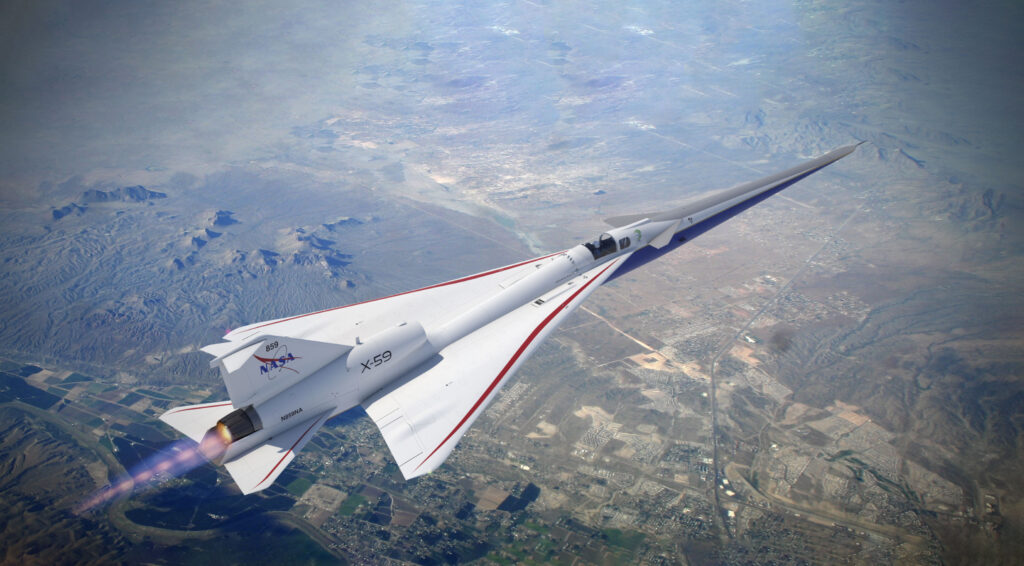
NASA's X-59 quiet supersonic research jet is being readied for its first flight. Its long, slender shape is designed to turn a sonic boom into a gentle thump, so regulators can consider lifting bans on supersonic flight over land.
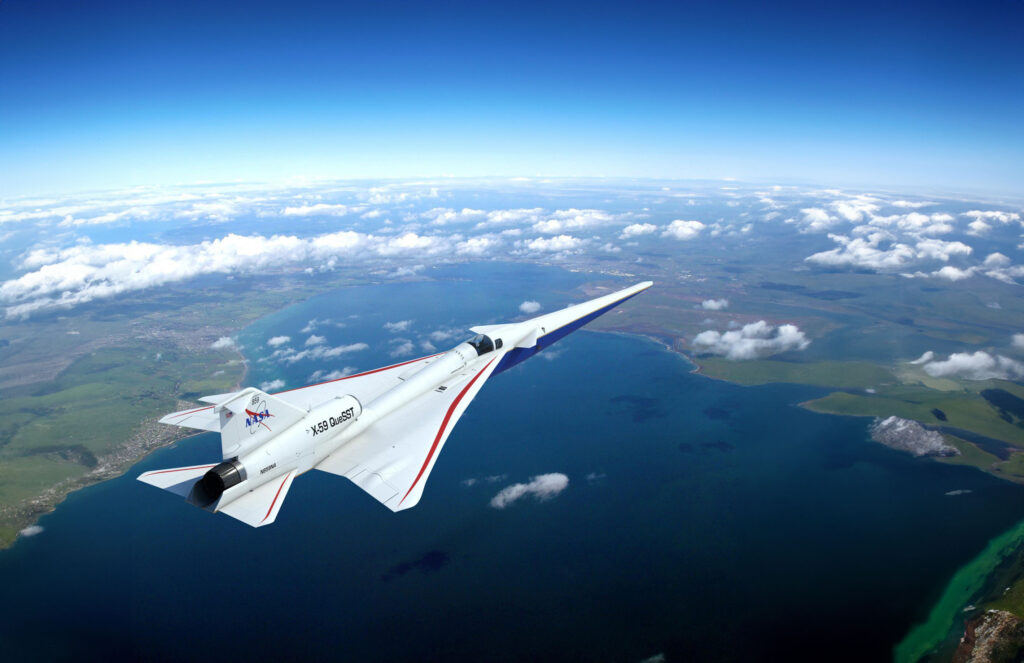
Imagine flying from New York to London at supersonic speed again, without the boom. This hyper-fast future of air travel is approaching liftoff as NASA prepares its trailblazing X-59 jet for a history-making inaugural test flight.
Dubbed the “Son of Concorde,” NASA’s bullet-nosed X-59 is designed to cruise at 925 mph at 55,000 feet.[1][2] Yet where the Concorde inaugurated the age of supersonic passenger travel in 1976,[3] the latest generation adds a unique twist: a refined aerodynamic shape to produce shockwaves so quiet it aims to convince regulators to lift bans on supersonic flights over land.
The milestone first flight caps years of painstaking development and signals a future where eight-hour journeys across the Atlantic give way to intercity hops faster than some current flights across the continental United States. But first, the almost 100-foot-long X-59 needs to get airborne.[1][2]
That day is a little closer. The aircraft moved to the flight line, the space between the hangar and the runway, in June,[4] and this month it went into the paint barn for its new blue, white and red livery.[5] Beyond looking sharp, the striking paint scheme serves crucial functions. Specialised coatings safeguard the aircraft against moisture and buffeting winds, while high visibility markings aid ground crews and pilots. Engineers also carefully weighed paint amounts, cautious that even minor weight additions could impact range estimates.
The X-59 is nearing the final safety checks required before its engines ignite and wheels leave terra firma. Confirmed to handle smoothly at target speeds, teams will calibrate systems and rehearse protocols to prepare both pilots and evaluator crew members tasked with characterising the craft’s acoustic signature during supersonic flight.
The goal is not to set cross-Atlantic speed records but to demonstrate that sonic booms need not preclude supersonic travel over populated areas. To do so, it will cruise communities exuding gentle sonic “thumps” for resident participants to gauge loudness firsthand.
The X-59 has been specifically designed to reduce the loudness of sonic booms, allowing supersonic flight over land. This is achieved through its long, slender fuselage and canards that prevent shockwaves from amalgamating. The uniquely shaped airframe is 99.7 ft long with a 29.5 ft wingspan[1][2] and should create a gentle 75 Perceived Level decibel thump on the ground.[6]
Propulsion comes from a single General Electric F414 engine that enables a maximum speed of Mach 1.5.[7] The aircraft will fly at Mach 1.4 or 925 mph at 55,000 ft for supersonic cruise.[1][2] The afterburner-equipped powerplant generates 22,000 pounds of thrust to overcome drag.[8][9] Since the pointed nose obstructs forward vision, Collins Aerospace supplies the avionics,[10] and NASA’s eXternal Vision System uses a 4K monitor to display real-time footage and telemetry.[11] Pilots will rely on this augmented graphical interface with a supplemental infrared camera for takeoffs and landings.
The cockpit canopy has been transplanted from a T-38 trainer jet, and the rugged landing gear comes from an F-16 fighter.[12] Ejection seats are installed as a safety measure during initial test flights of the experimental aircraft. NASA aims to gather community response data on the sound levels produced by the X-59. The information will support changing regulations to enable new overland commercial supersonic routes.
The public’s reaction is why NASA strains to develop the X-59 Quiet SuperSonic Technology aircraft, or QueSST.[13] By carefully analysing feedback alongside the vehicle’s acoustic measurements, the data can help convince hesitant regulators that new noise-mitigation practices make supersonic passenger planes viable without unsettling thunderclaps from the skies.
Success could mean restarting rapid, sustainable flight programs that have been mothballed since the Concorde retired in 2003,[3] with engineering expertise potentially attracting airframe orders to power an economic boon. Moving beyond one-off demonstrators, researchers ultimately envision supersonic airliners cutting US coast-to-coast journey times in half.[14]
Credit via aero-mag.com
The research airplane is 99 feet, 7 inches long; has a wingspan of 29.5 feet
Checked 25 November 2026
Mach 1.4, or 925 mph
Checked 25 November 2026
On 24 October 2003, British Airways withdrew Concorde, bringing to a close the world's only supersonic passenger service.
Checked 25 November 2026
NASA X-59 Moves Closer to Runway
the space between the hangar and the runway
Checked 25 November 2026
NASA’s X-59 Goes from Green to Red, White, and Blue
The aircraft made the move to the paint barn on Nov. 14, 2023.
Checked 25 November 2026
How loud is X-59’s shaped sonic boom?
The X-59 is designed to have a 75 PLdB sonic thump.
Checked 25 November 2026
New NASA X-Plane Construction Begins Now
Its top speed will be Mach 1.5, or 990 mph.
Checked 25 November 2026
X-Factor: 22,000 Pounds Of Thrust Just Got Quieter
can produce 22,000 pounds of thrust
Checked 25 November 2026
NASA Takes Delivery of GE Jet Engine for X-59
Nearly 13 feet long, three feet in diameter, and packing 22,000 pounds of afterburner enhanced jet propulsion
Checked 25 November 2026
Collins Aerospace delivers avionics for X-59 research aircraft
NASA's eXternal Vision System will allow X-59 pilots to safely navigate the skies
Checked 25 November 2026
NASA Completes Tests of X-59 External Vision System
A 4K-monitor serves as the central "window" allowing the pilot to safely see traffic in their flight path
Checked 25 November 2026
X-59 QueSST: More Than the Sum of Its Parts
Landing gear from an Air Force F-16 fighter
Checked 25 November 2026
Low-Boom Flight Demonstration lithograph
X-59 Quiet SuperSonic Technology (QueSST) aircraft
Checked 25 November 2026
Quesst for success: fly in half the time
Cutting U.S. coast-to-coast air-travel time in half
Checked 25 November 2026
Aerospace, Defence & Marine
Aerospace, Defence & Marine
Aerospace, Defence & Marine