3D Printed Catalysts: BASF Opens World-First Production Plant
BASF has launched the world's first industrial plant for 3D printed catalysts at Ludwigshafen, using X3D technology to boost reactor efficiency and cut energy use.
Key points
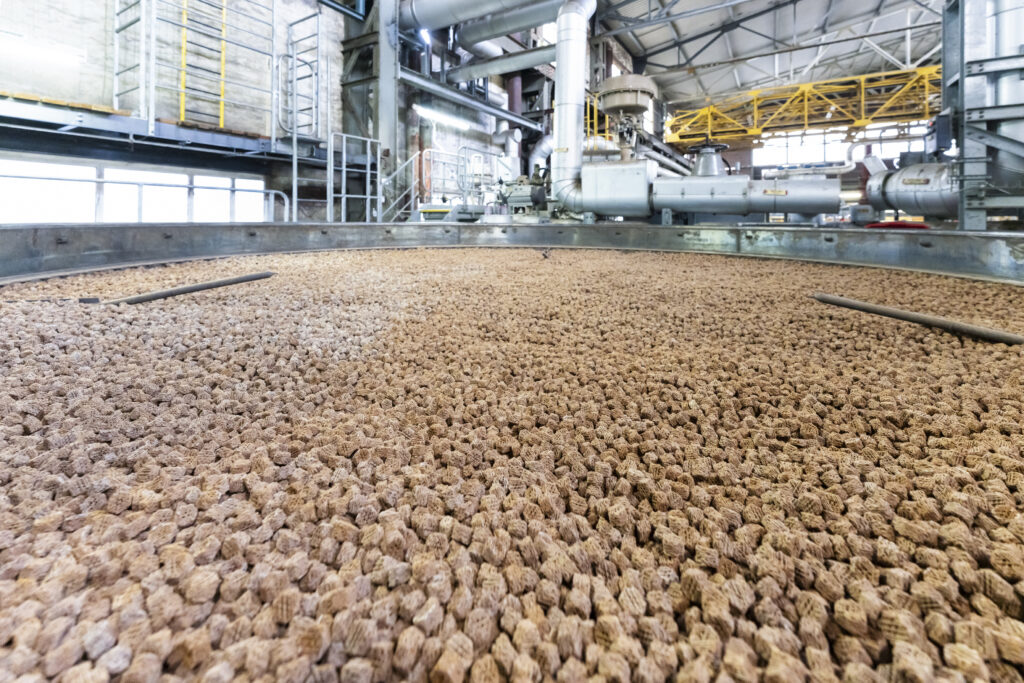
BASF has opened the world's first industrial-scale production plant for 3D-printed catalysts at its Ludwigshafen complex in Germany.
The X3D technology creates catalysts with optimised lattice geometries that reduce reactor pressure drop and increase active surface area.
Lower pressure drop means less energy consumption; greater surface area means better reaction efficiency and product quality.
The technology works across precious metals, base metals, and various support materials for applications from petrochemicals to fine chemicals.
At BASF’s sprawling chemical complex in Ludwigshafen, Germany, a production line unlike any other in the industry started up this month. The plant manufactures catalysts, the solid structures inside chemical reactors that speed up reactions without being consumed, using industrial 3D printing. It is the first facility in the world to produce 3D printed catalysts at commercial scale.
Catalysts are everywhere in industrial chemistry. They sit inside reactors in oil refineries, fertiliser plants, and pharmaceutical factories, enabling reactions that would otherwise be impossibly slow or energy-intensive. Conventionally, these catalysts are manufactured by pressing or extruding ceramic or metal powders into simple shapes: pellets, rings, or cylinders. The shapes are functional, but crude. For decades, chemical engineers have known that more complex internal geometries could improve performance, but the manufacturing technology to produce them at scale did not exist. Until now.
How 3D printed catalysts reshape reactor performance
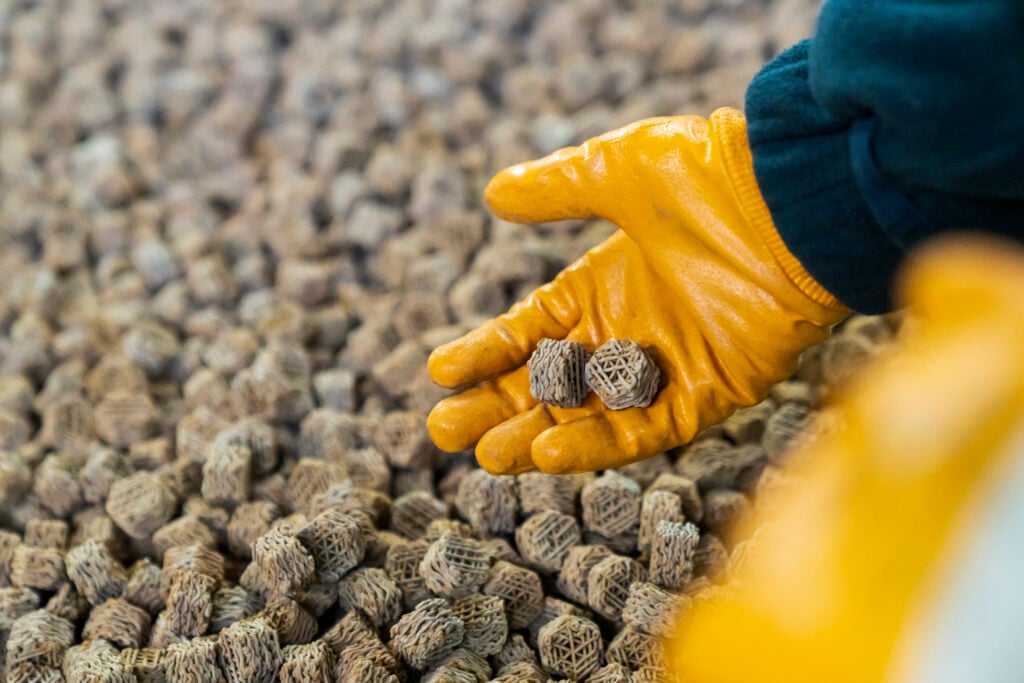
BASF’s X3D technology uses additive manufacturing to build catalysts layer by layer, creating structures with precisely controlled internal architectures. The result is a catalyst with an open, lattice-like geometry that allows gases and liquids to flow through a reactor with far less resistance. In engineering terms, the pressure drop across the reactor falls significantly. At the same time, the intricate internal surfaces increase the catalytically active area, giving reactant molecules more opportunities to interact with the catalyst material.
The combination is powerful. Lower pressure drop means pumps and compressors consume less energy to push feedstocks through the reactor. Greater active surface area means higher conversion rates and better product quality. In an industry where energy costs and reaction efficiency directly determine profitability, even modest improvements matter enormously. Scale those improvements across a facility processing thousands of tonnes of material per day, and the savings become substantial.
The technology is not limited to one type of chemistry. BASF says X3D works across precious metal catalysts, base metal catalysts, and various support materials, making it applicable to processes ranging from sulphuric acid production to fine chemicals and petrochemical refining. In 2025, Chinese fine chemical company An Hui Jintung filled a production plant with BASF’s X3D sulphuric acid catalysts and reported record production output.
Engineering deep dive
Why the shape of a catalyst matters as much as what it is made of
To understand what BASF has achieved, you need to think about what happens inside a chemical reactor. Imagine a vertical steel tube, perhaps two metres in diameter and ten metres tall, packed with thousands of catalyst pieces. A mixture of gases enters at one end, flows through the packed bed of catalyst, and exits at the other end as a different set of chemicals. The catalyst surfaces provide sites where reactant molecules adsorb, rearrange their bonds, and desorb as products.
Two things limit performance. The first is mass transfer: how effectively reactant molecules reach the catalyst surface. If the catalyst pieces are packed too tightly, gas struggles to flow between them. The pressure drop rises, meaning more energy is needed to force gas through the bed. A-level chemistry students will recognise this as related to the concept of surface area to volume ratio, one of the fundamental factors governing reaction rates.
The second limitation is heat transfer. Many catalytic reactions are exothermic, releasing heat. If that heat cannot dissipate evenly, hot spots form. Hot spots accelerate unwanted side reactions, degrade the catalyst, and can even damage the reactor vessel. The geometry of the catalyst pieces directly affects how gas flows around and through them, which in turn determines both mass and heat transfer characteristics.
Conventional catalyst shapes are compromises. A hollow cylinder, for example, offers reasonable flow-through while maintaining structural strength. But there is no way to optimise the internal geometry of a pressed or extruded shape beyond relatively simple modifications like adding holes or lobes. The manufacturing process constrains the design.
Additive manufacturing removes that constraint. With 3D printing, engineers can design catalyst structures with computer-optimised lattice architectures, internal channels, and graded porosity. The geometry can be tailored to the specific reaction conditions: temperature, pressure, flow rate, and the physical properties of the reactants. A catalyst for a high-pressure hydrogenation reactor might have a different internal structure from one designed for a low-pressure oxidation process, even if the active material on the surface is the same.
The X3D process builds these structures from ceramic or metal powders using binder jetting, a form of 3D printing where a liquid binding agent is selectively deposited onto thin layers of powder. After printing, the pieces are sintered (heated to fuse the particles together without fully melting them), then coated with the catalytically active material. The precision of the printing process means that each catalyst piece is essentially identical, reducing variability in reactor performance.
For students studying chemical engineering or materials science, this is a textbook example of how manufacturing technology can unlock performance improvements that were previously only theoretical. The underlying chemistry has not changed. The thermodynamics of the reactions are the same. What has changed is the ability to engineer the physical environment in which those reactions take place, down to the millimetre scale.
Links to the curriculum: A level, GCSE
The Ludwigshafen plant represents a bet that the rest of the chemical industry will follow where BASF has led. If 3D printed catalysts deliver the efficiency gains at scale that early adopters have reported, the technology could become standard across an industry responsible for roughly 10 per cent of global energy consumption. The gap between what chemical engineers could design and what manufacturers could build has, for the first time, closed to almost nothing.
Credit via interestingengineering.com
Share
Related stories
All Chemicals
Automotive & TransportInnovation
Sodium-Ion Battery for Electric Vehicles Enters Production
Energy & EnvironmentBreakthroughs
Zinc Slurry Battery Runs 5,128 Hours in Lab Tests