Construction & Infrastructure
Antares Nuclear's Mark-0 microreactor achieved nuclear criticality at Idaho National Laboratory on 4 June 2026, the first advanced reactor to do so under the DOE pilot programme.
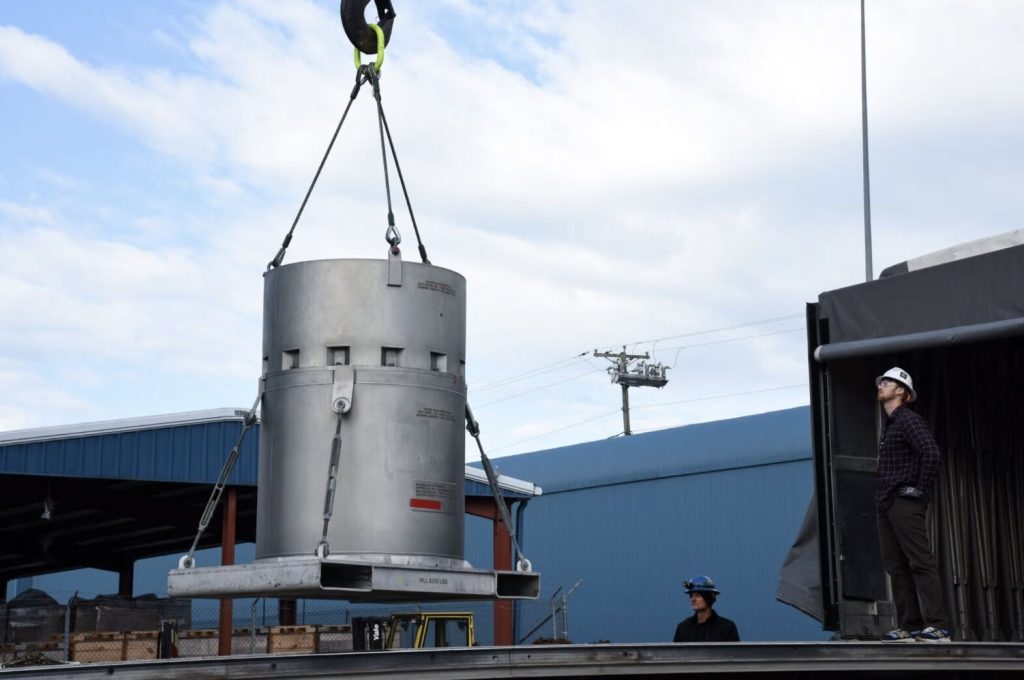
The last time a genuinely new type of nuclear reactor went critical in the United States, Ronald Reagan was in the White House. That streak ended on 4 June 2026, in a concrete bunker at Idaho National Laboratory, when Antares Nuclear’s Mark-0 achieved a self-sustaining chain reaction for the first time.
The Mark-0 is not a power station. It is a demonstrator, a proof that Antares’s sodium heat-pipe-cooled microreactor design actually works as the physics models predict. But the milestone, announced by the US Department of Energy, is the first achieved under the federal Reactor Pilot Programme, and the first criticality of a privately developed non-light-water reactor in America in more than four decades.
Criticality is the point at which a nuclear reactor sustains a chain reaction without external help. Neutrons released by fissioning atoms strike other atoms, which fission in turn, releasing more neutrons in an unbroken cycle. Below criticality, the reaction fizzles. At criticality, it holds steady. The Mark-0’s zero-power test confirmed that the reactor reaches and maintains this balance, validating both the fuel design and the core geometry.
The reactor itself is small enough to fit on a large lorry. Microreactors, as the name suggests, are designed to produce between 1 and 20 megawatts of thermal energy, enough to power a remote military base, a mining operation, or a small community cut off from the grid. Antares expects to generate electricity from the Mark-0 by 2027 and to deploy operational units at military installations by 2028.
The fuel is HALEU TRISO, a type of uranium fuel that encases tiny kernels of high-assay, low-enriched uranium in layers of ceramic and carbon. Each fuel particle, smaller than a peppercorn, is its own containment vessel. Even if the reactor overheats, the TRISO coating holds, preventing the release of radioactive material. It is a fundamentally different safety philosophy from that of the water-cooled reactors that dominate the current fleet, which rely on active cooling systems and external power to prevent meltdowns.
Heat removal in the Mark-0 uses sodium-filled heat pipes rather than pumped coolant loops. Each pipe is a sealed metal tube containing a small quantity of sodium. Heat from the fuel vaporises the sodium at one end, it travels as vapour to the cooler end, condenses, and wicks back through capillary action: no pumps, no moving parts, no reliance on external power. If the reactor shuts down, the heat pipes continue to passively transfer residual heat.
Jordan Bramble, CEO of the California-based company, credited the programme’s speed to the DOE’s streamlined authorisation process. The Reactor Pilot Programme, established under executive order, bypasses some of the traditional regulatory stages that have historically added years and billions to reactor construction timelines.
Engineering deep dive
The physics of nuclear criticality is something A-level students encounter when studying radioactive decay and nuclear fission. The concept of a chain reaction is straightforward in principle: uranium-235 absorbs a neutron, splits into two lighter nuclei, releases energy and two or three additional neutrons, and those neutrons go on to cause further fissions. The engineering challenge is controlling this process precisely.
The key parameter is the neutron multiplication factor, k. When k equals exactly 1, the reactor is critical: each generation of fissions produces exactly enough neutrons to sustain the next generation. Below 1 (subcritical), the reaction dies away. Above 1 (supercritical), it grows. A zero-power criticality test, such as the Mark-0's demonstration, carefully approaches k = 1 from below, adding fuel or adjusting control elements incrementally until the neutron population stabilises.
The Mark-0 uses TRISO (tri-structural isotropic) fuel particles, each roughly 0.9 millimetres in diameter. At the centre sits a kernel of uranium oxycarbide enriched to just under 20 per cent U-235 (the HALEU threshold, for high-assay low-enriched uranium). Surrounding this kernel are four concentric layers: a porous carbon buffer that accommodates fission-gas pressure, an inner pyrolytic carbon layer, a silicon carbide shell that serves as the primary pressure vessel, and an outer pyrolytic carbon layer. This structure has been tested to temperatures exceeding 1,600 degrees Celsius without failure, well above the operating temperature of the Mark-0 core.
The sodium heat pipe cooling system warrants detailed examination. A heat pipe exploits the latent heat of vaporisation, a concept from A-level thermodynamics. Sodium melts at 98 degrees Celsius and boils at 883 degrees Celsius at atmospheric pressure. Inside the sealed pipe, a wick structure (typically a sintered metal mesh) lines the inner wall. The fuel heats the evaporator end of the pipe, boiling the sodium. The vapour travels to the condenser end, where it releases its latent heat to a secondary system, condenses into liquid, and is drawn back to the evaporator by capillary forces in the wick. The beauty is that this cycle requires no external pumps or power. It is entirely passive and self-regulating: if the heat input increases, more sodium evaporates, transferring more heat.
Compare this to a conventional pressurised water reactor (PWR), where water must be pumped continuously through the core at pressures exceeding 150 atmospheres. If the pumps fail, as they did at Fukushima when the tsunami knocked out backup generators, the water boils away, and the fuel melts. The Mark-0's passive cooling eliminates this entire failure mode.
The modular, factory-built approach also changes the manufacturing engineering. Conventional nuclear plants are constructed on site, a bespoke process that invites delays and cost overruns. Microreactors are designed for factory assembly and truck delivery. Standardised production lines could drive costs down through repetition, the same manufacturing logic that made jet engines affordable after decades of one-off production.
For students considering nuclear engineering as a career, the field is undergoing its most significant transformation since the 1950s. The UK's own programme of small modular reactors, led by Rolls-Royce SMR, is on a parallel track, with the first unit expected at a site in Cumbria by the early 2030s.
Links to the curriculum: A level, GCSE
The Mark-0 is the 53rd reactor built at the Idaho site since 1951, a lineage that includes the reactors whose designs became the blueprints for America’s current commercial fleet. Whether microreactors follow the same path from prototype to widespread deployment depends as much on economics as on engineering. Antares has demonstrated that the physics works. The next question is whether anyone will buy it.
Credit via energy.gov
Construction & Infrastructure
Energy & EnvironmentBreakthroughs
Energy & Environment
Energy & Environment