Automotive & Transport
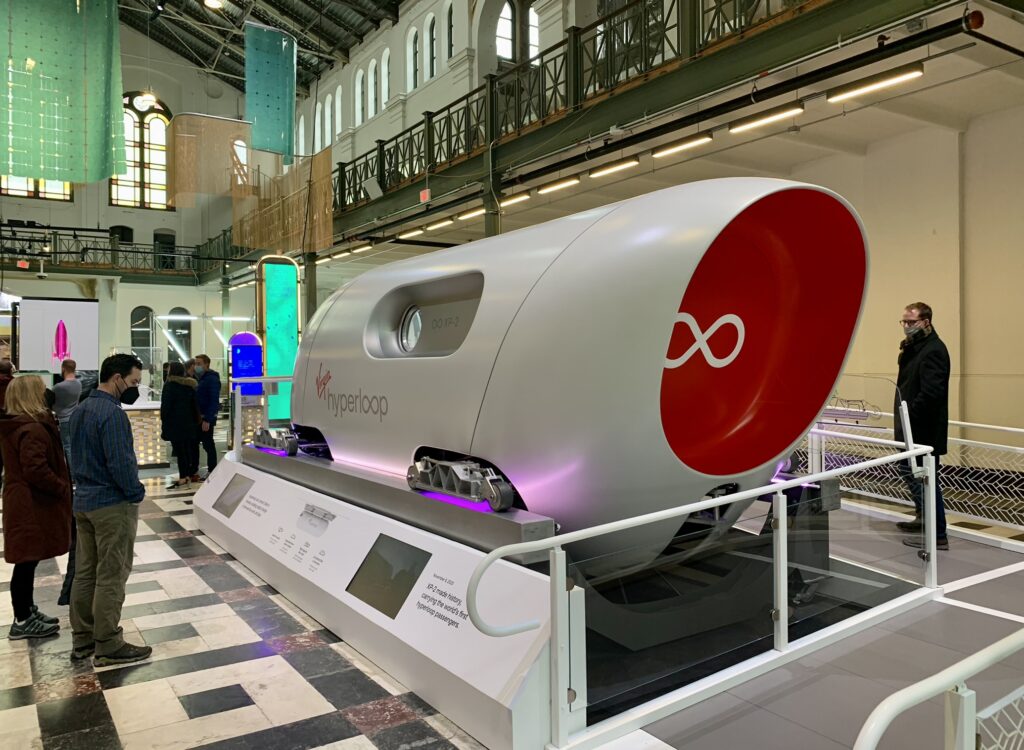
The concept of the hyperloop – ultra high-speed transportation via pods or capsules travelling in near-vacuum tubes – originated in 2013 with a white paper by Elon Musk. This sci-fi-esque idea quickly captured the public imagination and spurred several startups to attempt to turn the Hyperloop into reality.
One of the most prominent was Hyperloop One, founded in 2014, which promised to deliver superfast intercity travel and revolutionize transportation. After nearly a decade of development filled with lofty visions but tiny real-world implementation, Hyperloop One has reached the end of its journey.

After struggling for years to validate its Hyperloop technology and achieve commercial success, Hyperloop One has ceased operations. It failed to secure a single contract to build working hyperloops despite raising over $450 million in funding.[1] Its assets are being liquidated, and the remaining employees will be laid off by the end of 2023.[2]
So what exactly is Hyperloop, and why did Hyperloop One fail to deliver on its promises?
In principle, hyperloops involve loading passengers or cargo into pods or capsules, which are propelled through specially built near-vacuum tubes at airline-like speeds of 700 mph. This is enabled by magnetic levitation and lack of air resistance. Hyperloop networks can connect cities less than about 900 miles apart.[3]
Key benefits included:
However, there were also significant unsolved challenges around:
Hyperloop One was established in 2014 to realize hyperloops, raising over $400 million by 2019, including from significant backers like DP World and Richard Branson’s Virgin Group.
It started strong – building substantial test infrastructure in Nevada, including a 500m tube and levitation rig.[5] In early 2022, the company pivoted to focus more on cargo transport.[6]
By 2020, Hyperloop One successfully conducted a crewed test run hitting 100 mph. However, this still fell far below the design goal of 700 mph.
There were also technology hurdles as well as setbacks around sexual harassment allegations against executives, lawsuits between founders, and leadership churn.
In 2022, the company again pivoted, shedding its Virgin brand affiliation.[6] Despite a change to focus purely on cargo transport, Hyperloop One failed to convince any commercial partners.
The firm has begun asset liquidation and closure with dwindling funds. All intellectual property is transferred to investor DP World.[7]
We need to dive into some physics concepts around motion and friction to understand how the hyperloop works.
The critical goal is achieving speeds comparable to an aircraft over 700 mph. The hyperloop eliminates sources of drag and friction, holding back regular trains to make this feasible on the ground.
Let’s look at the equation for drag force:
FD = 0.5 x ρ x v2 x CD x A
This depends directly on the density (ρ) of the fluid you’re moving through. For hyperloop pods, that’s air. By putting the pod or capsule inside a tube that has had almost all the air removed, the density drops substantially, taking drag down proportionally. We’re talking near-vacuum conditions, around 100 pascals of pressure, equivalent to 150,000 ft altitude![8]
You also want to minimize the drag coefficient CD by streamlining the capsule’s shape – a teardrop is ideal. This also reduces the frontal area A. Less drag means the pods can accelerate faster and cruise with minimal ongoing propulsion needed.
So that covers reducing air resistance. But what about friction against the track itself? Train wheels rolling on rails have much friction. This is eliminated in the hyperloop thanks to magnetic levitation or “maglev” technology.
Powerful electromagnets on the capsule lift it up and precisely control the stability. This lets it float entirely contact-free above the track surface. It can glide easily across hundreds of miles by maintaining the pod just 15-20mm off the rail. No friction also means improved efficiency. Linear induction motors propel the levitating pods using electromagnetic forces.
Lastly, super straight and smooth tubes allow near-supersonic speed without veering off-course. Sophisticated sensors help steer and stabilize the hyperloop pods. Precision engineering and guidance keep everything perfectly aligned even while doing 700+ mph.
Combining aerodynamics principles, electromagnetic levitation, linear propulsion, and precision guidance makes the hyperloop’s unprecedented velocity technically feasible. This is how high-tech transit pushes boundaries for faster intercity travel times.
A few hyperloop startups still exist, such as Canada-based TransPod. However, significant infrastructure and commercialization still need to be developed.
Technical barriers around high speeds, passenger safety, and strong political support for existing transit modes have hindered large-scale rollout. Regulatory approval processes for such novel technology also pose challenges. With Hyperloop One unable to deliver working hyperloops, the hyperloop concept remains academic rather than market-ready.
The closure of Hyperloop One signals fading momentum for hyperloops as a revolutionary near-future mode of transportation. Still, the journey did deliver a host of new engineering developments. Initiatives like Hyperloop One helped spur research and understanding of tunnelled, high-speed transit technologies. Concepts pioneered around magnetic levitation, efficient electric propulsion, and advanced materials science may find applications elsewhere. The hyperloop vision also highlighted the need for sustainable mobility.
Credit via techcrunch.com
Hyperloop One shut down (Bloomberg)
Hyperloop One raised more than $450 million since its founding in 2014
Checked 14 October 2026
Hyperloop One shut down (Bloomberg)
The remaining workers, tasked with overseeing the asset sale, were told their employment will end on Dec. 31.
Checked 14 October 2026
the specific case of high traffic city pairs that are less than about 1500 km or 900 miles apart.
Internet Archive copy (tesla.com blocks automated access)
Checked 14 October 2026
The total one-way trip time is 35 minutes from county line to county line.
Internet Archive copy (tesla.com blocks automated access)
Checked 14 October 2026
Virgin Hyperloop Makes History With the First Passenger Testing
The test took place at Virgin Hyperloop’s 500 meter DevLoop test site in Las Vegas, where the company has previously run over 400 un-occupied tests.
Internet Archive copy (virginhyperloop.com no longer online)
Checked 14 October 2026
Hyperloop One is reportedly shutting down
pivoted its focus to cargo in early 2022
Checked 14 October 2026
Hyperloop One shut down (Bloomberg)
The startup's remaining intellectual property will be transferred to DP World
Checked 14 October 2026
This is an operating pressure of 100 Pascals, which reduces the drag force of the air by 1,000 times relative to sea level conditions and would be equivalent to flying above 150,000 feet altitude.
Internet Archive copy (tesla.com blocks automated access)
Checked 14 October 2026
Automotive & Transport
Construction & Infrastructure
Automotive & Transport