
Collapsible Bicycle Helmets Protect Less on Average, Imperial Tests Find
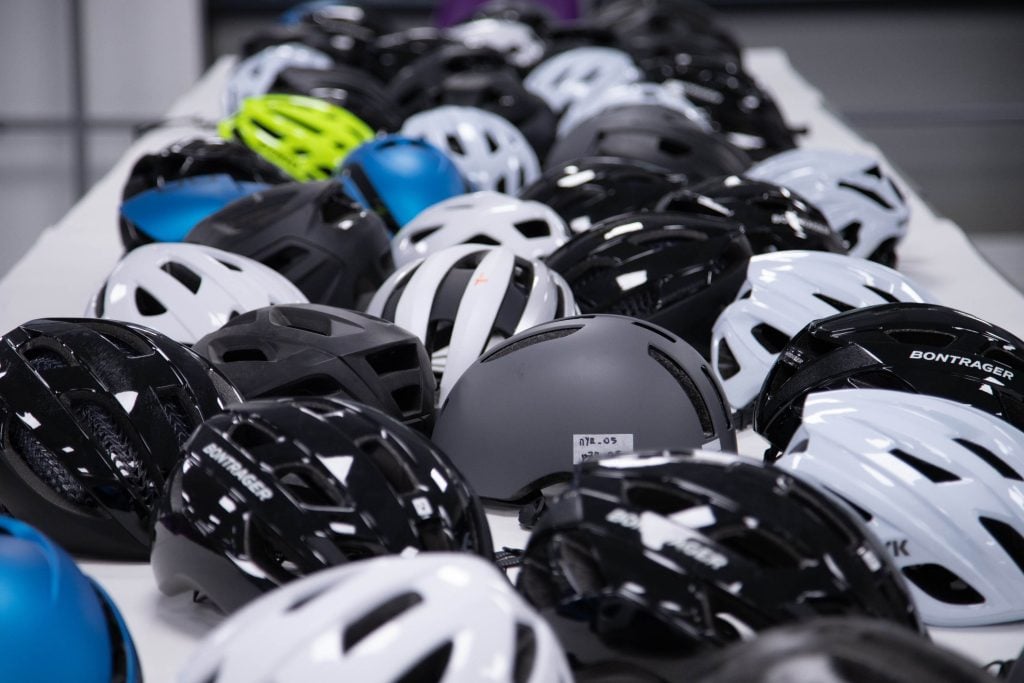
Imperial College London engineers crash-tested 30 bike helmets at real-world angles. Folding designs met the safety standards but protected less on average, mostly because they were heavier.
Key points
- Imperial College London's HEAD Lab tested 30 bike helmets, including all six collapsible models sold in the UK.
- All met the minimum safety standards, but in angled impact tests the collapsible ones gave a 24% average predicted risk of linear injury against 20% for conventional helmets.
- Collapsible helmets were 57% heavier on average, and extra weight raises risk.
- A folding helmet with rotational protection ranked 2nd of 30, so the gap can be closed by better design.
If you line up 30 bicycle helmets on a lab bench, they all seem similar: foam shells, air vents, chin straps. But when you test them the way a cyclist’s head actually hits the road - at an angle - the differences become clear. Engineers at Imperial College London did just that and discovered that collapsible bicycle helmets, which fold flat to fit in a bag, generally offer less protection than regular helmets.
Researchers from the HEAD Lab at Imperial’s Dyson School of Design Engineering tested 30 helmets sold in stores - 24 regular models and all six collapsible models available in the UK.[1] All the helmets met the minimum safety standards required by regulations.[2] The difference only showed up in a test that these standards don’t include.
Current certification tests drop helmets straight down and mostly measure the direct force of the impact.[3] However, most cycling crashes happen at an angle, causing the head to rotate quickly.[4] To reflect this, the Imperial team hit each helmet at four different spots, repeated each test three times with a new helmet, and used a tall drop rig to measure both straight and rotational head movements.[5][6]
What the tests found on collapsible bicycle helmets
On average, the predicted risk of a straight-impact injury was 24% for collapsible helmets and 20% for regular ones.[7][8] For brain injuries caused by head rotation, the team found no difference between the two types.[9] Still, five out of six collapsible helmets ended up in the lower half of the protection rankings.
Weight plays a major role here. Collapsible helmets were about 57% heavier than regular ones, averaging 461 grams compared to 294 grams.[10][11] The researchers estimate that every extra 10 grams adds about 0.2% more risk. Paying more doesn’t mean better safety either: the collapsible helmets in the study cost £101 on average, while regular ones cost £64.[12]
There is good news for designers: the gap isn’t an unavoidable part of folding helmets. One example proves this. The Newlane Foldable with MIPS, a system for rotational protection, ranked second out of all 30 helmets, while the version without MIPS came in 26th.[13] Only one of the six collapsible helmets had rotational protection, compared to 12 out of 24 regular helmets.[14]
Lead author Dr William Dawber understands why folding designs are popular: “Collapsible helmets are a great solution to overcome inconvenience.”[15] Professor Mazdak Ghajari, Professor of Brain Biomechanics and founder of the HEAD Lab, also emphasizes that people should keep using them: “Any helmet is safer than no helmet and innovative designs that appeal to more people are to be applauded.”[16]
Biomechanics is the field that turns crash forces into injury risk, and it’s one of the areas covered in our guide to biomedical engineering careers. You can find the full results in Imperial’s announcement and in BikeRadar’s report.
Engineering deep dive
Why a few millimetres of foam matter
A helmet cannot stop your head hitting the road. What it can do is make the stop longer. The foam liner crushes, and every extra millimetre it crushes spreads the same change in speed over more distance and more time. That lowers the deceleration, and deceleration is what injures the brain.
Step 1: how fast is the head going? Take, as an assumption, a head falling from about 1.8 m, roughly the height of a cyclist's head. Using v² = 2gh from GCSE and A-level Physics: v = √(2 × 9.81 × 1.8) ≈ 5.9 m/s. Call it 6 m/s.
Step 2: how hard is the stop? Assume the foam crushes 20 mm and brings the head to rest at a steady rate. From v² = u² + 2as, the deceleration is a = v² ÷ 2s = 36 ÷ (2 × 0.020) = 900 m/s². That is about 92 times the acceleration due to gravity, or 92 g.
If the foam only gives 15 mm of useful crush, a = 36 ÷ 0.030 = 1,200 m/s², about 122 g. Losing a quarter of the crush distance raises the peak by a third. That is why the thickness, density and shape of the foam are among the first things a helmet engineer works on.
Step 3: how big is the force? Assume a head mass of 4.5 kg. Newton's second law, F = ma, gives 4.5 × 900 ≈ 4,000 N, about the weight of 400 kg resting on your skull for a split second.
Step 4: where does weight come in? A heavier helmet adds mass that has to be stopped along with the head. The collapsible helmets were 167 g heavier on average (461 g minus 294 g). On the researchers' estimate of 0.2% extra risk per 10 g, that is 16.7 × 0.2 ≈ 3.3%. If that figure is read as percentage points, weight alone would account for much of the 4-point gap in linear injury risk; the published paper is the place to check exactly how the team modelled it.
Step 5: why angles matter. In an angled impact, the road pushes sideways on the helmet as well as upwards. A sideways force acting some distance from the centre of the head creates a turning moment, so the head spins. Rotational protection systems aim to let the helmet shell slide a little relative to the head, reducing that spin. Moments and rotation turn up in A-level Physics and the mechanics part of A-level Maths.
Links to the curriculum: A level, GCSE
What happens next
The researchers believe that adding rotational protection and reducing weight could close the safety gap, and they share their results so manufacturers can make better helmets. The challenge now is to design a helmet that folds up small, stays light, and still gives the foam enough space to crush. That’s a design problem any engineering student could start working on today.
What this means for you
This study involved design engineers who create helmet shells and foams, biomechanics researchers who translate crash forces into injury risk, and test engineers who operate drop rigs and analyze sensor data. These careers usually begin with a degree in design, mechanical, or biomedical engineering, and our guide to mechanical engineering careers explains the different paths, including vocational options. Physics connects everything, and our guide to A-level Physics for engineering shows how learning about forces and motion can lead to a career.
Image: Imperial College London
Credit via imperial.ac.uk
Further reading
Sources
16 sources
tested 30 commercially available helmets, including 24 conventional models and all 6 collapsible models available in the UK
Checked 10 November 2026
all helmets included in the study met the minimum regulatory standards for safety
Checked 10 November 2026
use a vertical drop test that primarily measures direct impact forces without accounting for oblique impacts
Checked 10 November 2026
most cycling impacts occur at an angle, causing the head to rotate sharply
Checked 10 November 2026
Each impact was repeated three times using a new helmet sample
Checked 10 November 2026
Collapsible bicycle helmets pass safety standards but offer less protection, study finds
using a tall drop rig to measure linear and rotational head motion
Checked 10 November 2026
the average predicted risk was 24% for collapsible helmets, compared with 20% for conventional helmets
Checked 10 November 2026
Collapsible bicycle helmets pass safety standards but offer less protection, study finds
The average predicted risk of a linear injury was 24% for collapsible helmets compared to 20% for conventional helmets.
Checked 10 November 2026
The study found no difference in protection against brain injuries caused by head rotation.
Checked 10 November 2026
Collapsible helmets were on average 57% heavier than conventional helmets (461 grams versus 294 grams).
Checked 10 November 2026
Collapsible bicycle helmets pass safety standards but offer less protection, study finds
Collapsible helmets were on average 57% heavier than conventional helmets (461g versus 294g).
Checked 10 November 2026
collapsible helmets purchased for this study cost £101 on average, compared with £64 for conventional helmets.
Checked 10 November 2026
The MIPS-equipped helmet ranked 2nd among the 30 helmets
Checked 10 November 2026
were used in only 1 of 6 collapsible helmets, compared with 12 of the 24 conventional helmets
Checked 10 November 2026
Collapsible helmets are a great solution to overcome inconvenience
Checked 10 November 2026
Any helmet is safer than no helmet and innovative designs that appeal to more people are to be applauded.
Checked 10 November 2026
Share
Related stories
All Health

HealthInnovation
Brain Computer Interface Implant Gets First Commercial Approval
HealthInnovation