
Construction & Infrastructure
University of Surrey engineers have built a simpler set of equations to check whether a concrete floor can survive losing a column without starting a progressive collapse, and tested it against a real car park failure in Spain.
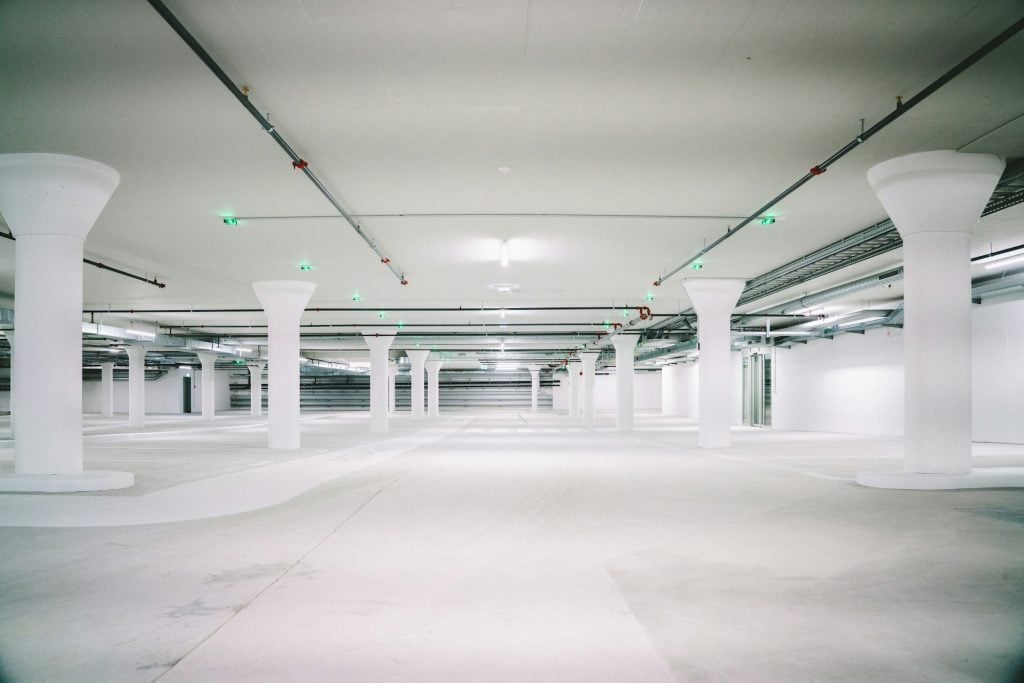
If you walk through a multi-storey car park, you'll find yourself under a concrete slab supported by many columns. Each column holds up part of the floor above and all the cars parked there. But what if one column suddenly fails? Would the floor just dip, or could it trigger a bigger problem? Engineers at the University of Surrey have found a simpler way to answer this and help make sure nothing dramatic happens.
This research, led by Surrey and published in Structural Concrete, offers engineers an easier way to check how reinforced concrete floors react if a support column suddenly fails.[1] The focus is on a failure called punching shear, where a column pushes through the slab above.[2] If one column goes, its weight shifts to the nearby columns, which can sometimes set off a chain reaction called progressive collapse.[3]
Usually, checking for this kind of failure involves long, complicated calculations. The Surrey team has created a set of equations that make things simpler. With these, engineers can figure out how much steel reinforcement a floor needs to prevent one failure from causing more.[4] The method also works with the upcoming version of Eurocode 2, the European standard for concrete design, so it matches the rules designers will use.
Engineers call a building that can handle this kind of damage and stay standing robust. That's even in the job title of Professor Juan Sagaseta, Surrey's Professor of Structural Robustness. “The loss of a single column should not mean the loss of an entire building,” he said[5].
Equations only matter if they work in real life. The team tested theirs with past experiments and new data from the 2020 collapse of the Nueva Montaña car park in Santander, Spain.[6] On January 13, 2020, a children's play area with a sports court, built above an underground car park, sank onto the parking below early in the morning.[7] Spanish engineers later published their own analysis of why the concrete slab failed.[8]
The new equations correctly predicted the kind of failure seen at the site, where damage spread from a failed column to its neighbor. The researchers also found their method works even if more than one column suddenly fails.
Lead author Dr Maria Liapopoulou did this research while she was a Research Fellow at Surrey and is now a Brunel Fellow at the University of Cambridge[9]. “It’s one thing to develop a mathematical model, but being able to test it against a real case study gives us greater confidence that it could make a difference in practice,” she said[10].
The team worked with Universidad Politécnica de Madrid, Universidad de Extremadura, and the design firm Skidmore, Owings & Merrill (SOM).[11] Having a design firm involved is important because the goal is a check that engineers can use on real projects, not just a result for a journal. And if you're curious why a UK university studied a Spanish car park, it's because concrete acts the same way in Santander as it does in Surrey.
Engineering deep dive
Let's put rough numbers on it. Take a typical flat-slab car park with columns on a grid 7.5 m by 7.5 m (an assumption for this example). Each internal column holds up a patch of floor 7.5 × 7.5 = 56.25 m². Assume the slab, finishes and parked cars together weigh 10 kN for every square metre (another assumption).
Load on one column = 56.25 m² × 10 kN/m² ≈ 562 kN, about the weight of 57 tonnes.
Now remove that column. Its load has to go somewhere. If the four nearest columns share it equally, each picks up 562 ÷ 4 ≈ 141 kN extra, a 25% rise. But the column did not fail politely. A load that arrives suddenly can briefly push a structure up to about twice as hard as the same load applied slowly, for the same reason bathroom scales overshoot if you jump onto them. So at the worst moment a neighbour could see 562 + 2 × 141 ≈ 844 kN, roughly 50% more than normal.
Punching shear is about how that force spreads into the slab around the column. A simple way to picture it is stress = force ÷ area. Assume a 400 mm square column and a slab with an effective depth of 250 mm, and imagine a "collar" of concrete 0.5 m out from the column faces. Its perimeter is the four straight sides plus four quarter circles:
u = 4 × 0.4 + 2π × 0.5 ≈ 4.74 m
The area of concrete resisting the punch is u × depth = 4.74 × 0.25 ≈ 1.19 m². Normal shear stress: 562 ÷ 1.19 ≈ 470 kPa (0.47 MPa). Worst moment after a column loss: 844 ÷ 1.19 ≈ 710 kPa (0.71 MPa).
Same slab, same concrete, half as much stress again. That is exactly the gap the Surrey equations help designers close, by telling them how much reinforcement to add so the slab can carry the peak without punching through. Stress, force and area are at the heart of A-level Physics, and our guide to how a Physics A-level prepares you for engineering shows where that leads.
Links to the curriculum: A level, GCSE
These equations address one major way a concrete floor can fail, but they still need to become part of everyday design practice. Steel frames, timber buildings, and floors with big openings behave differently. The next step is to see if design engineers start using this method as the new Eurocode 2 comes into effect.
Structural engineers design concrete frames to survive damage, and forensic engineers study failures like the one in Santander to make future buildings safer. Most structural engineers begin with a civil or structural engineering degree or a degree apprenticeship - our guide explains the difference. The maths here comes straight from A-level, so it's worth reading how a Maths A-level prepares you for engineering.
Image: Claudio Schwarz on Unsplash
Credit via surrey.ac.uk
New engineering method could help prevent buildings collapsing after column failure
In a study published in Structural Concrete, researchers introduce a simpler way for engineers
Checked 3 November 2026
New engineering method could help prevent buildings collapsing after column failure
where the column effectively punches through the concrete slab above it.
Checked 3 November 2026
New engineering method could help prevent buildings collapsing after column failure
the extra load can potentially trigger a chain reaction known as progressive collapse.
Checked 3 November 2026
New engineering method could help prevent buildings collapsing after column failure
The method allows engineers to assess how much reinforcement might be needed to prevent further structural failure
Checked 3 November 2026
New engineering method could help prevent buildings collapsing after column failure
The loss of a single column should not mean the loss of an entire building.
Checked 3 November 2026
New engineering method could help prevent buildings collapsing after column failure
the collapse of the Nueva Montaña car park in Santander, Spain, in 2020.
Checked 3 November 2026
Se hunde un parque sobre el aparcamiento de una urbanización de Santander
Un parque infantil con pista deportiva se ha hundido a primera hora de esta mañana sobre el aparcamiento subterráneo
Checked 3 November 2026
ANALYSIS OF CAUSES OF THE COLLAPSE OF REINFORCED CONCRETE SLAB IN 2020 IN PARKING LOCATED IN URBANIZATION NUEVA MONTAÑA. SANTANDER.
Checked 3 November 2026
New engineering method could help prevent buildings collapsing after column failure
now a Brunel Fellow at the University of Cambridge, who conducted the research while working as a Research Fellow at the University of Surrey
Checked 3 November 2026
New engineering method could help prevent buildings collapsing after column failure
It's one thing to develop a mathematical model, but being able to test it against a real case study gives us greater confidence that it could make a difference in practice.
Checked 3 November 2026
New engineering method could help prevent buildings collapsing after column failure
Universidad Politécnica de Madrid, Universidad de Extremadura and industry partner Skidmore, Owings & Merrill (SOM)
Checked 3 November 2026
Construction & Infrastructure

Construction & Infrastructure

Construction & Infrastructure
Construction & Infrastructure