Bristol Start-Up Shrinks Hospital Eye Scanner Onto a Chip Smaller Than a £1 Coin
Bristol start-up Siloton wins £8.4 million from Innovate UK to develop GiraffeOCT, a handheld retinal scanner built on a photonic chip. It could bring hospital-grade eye imaging into GP surgeries and homes, helping clear NHS ophthalmology waiting lists.
Key points
- Bristol company Siloton has won £8.4 million from Innovate UK to develop a handheld retinal scanner called GiraffeOCT
- The device uses a photonic chip called BlueJay that replaces a tabletop OCT machine costing tens of thousands of pounds
- Clinical trials will run at Sunderland Specialist Eye Hospital, with a home-use version planned
- Ophthalmology is the busiest NHS outpatient specialty, with 623,000 people on waiting lists for eye care
The Bristol-based company Siloton has secured an £8.4 million[1] contract from Innovate UK to create a handheld retinal scanner that will enable hospital-standard eye imaging in general practice surgeries, by opticians, and ultimately in people’s homes.
At its core the technology uses a photonic chip called BlueJay; this chip packs the optics needed for optical coherence tomography - a scanning method normally done with a desktop machine costing tens of thousands of pounds - onto a chip small enough to balance on your fingernail.
Ophthalmology is the busiest outpatient specialty within the NHS, with around nine million appointments[2] each year. Currently, over 623,000[3] people are waiting for eye care. Siloton’s device, the GiraffeOCT, could allow clinicians to screen patients outside hospitals and detect conditions like age-related macular degeneration earlier, when treatment is most effective.
How it happened
Siloton was set up in Bristol and received an Institute of Physics[4] business innovation award in 2023. In 2024 it became the first commercial organisation[5] to obtain subsurface images of a human retina using its first-generation Akepa photonic chip. The following year, they carried out their first patient trial, imaging retinas to detect and monitor age-related macular degeneration. A second group of patients was imaged in early 2026.
The £8.4 million contract, announced in October 2026, will cover two years of clinical development. Siloton will carry out clinical trials on an in-clinic version of GiraffeOCT at Sunderland Specialist Eye Hospital[6]. The trials will involve a prototype with better ergonomics and extra post-processing, moving the product beyond research use to one suitable for everyday clinical use.
Alasdair Price, who is the CEO of Siloton, stated that the contract “will shorten the time it takes to bring the medical device to market by one to two years”.
The identical BlueJay chip architecture is also being used in a system intended for astronauts, although Siloton has not yet released details about that project.
Two versions planned
Siloton is creating GiraffeOCT in two forms: the in-clinic version is a handheld device used by qualified clinicians, and the at-home version includes built-in automation and guidance that enable patients to take their own retinal images without a clinician present.
A research device of second generation, the CheetahOCT, is expected around early 2027; it will be capable of measuring the various layers of the retina and of detecting a broader range of conditions. Price stated, “The image performance[7] will be considerably better, with the result that the number of biomarkers it can be used to measure will increase.”
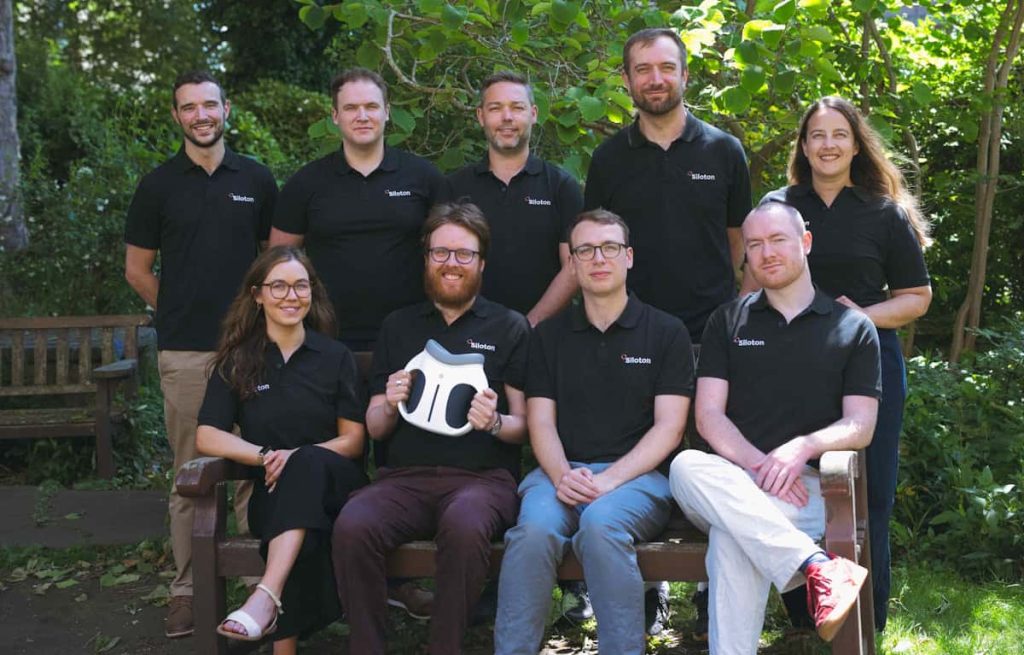
The company anticipates that its workforce will have increased to 16 employees by August 2028.
Engineering deep dive
How OCT Works, and Why Shrinking It Matters
Optical coherence tomography works a bit like ultrasound, but with light instead of sound. A beam of near-infrared light is directed into the eye. As it passes through the layers of the retina, some light reflects back from each boundary between different tissue types. By measuring the time delay and intensity of these reflections, the system builds a cross-sectional image of the retina's internal structure.
The critical component is an interferometer. The device splits the light beam in two. One half goes into the patient's eye. The other hits a reference mirror at a known distance. When the two beams recombine, they create an interference pattern that encodes depth information. A detector reads this pattern, and software reconstructs it into an image.
In a conventional hospital OCT machine, the interferometer is built from discrete optical components: beam splitters, lenses, mirrors, and fibre-optic couplers, all mounted on an optical bench inside a unit roughly the size of a desktop printer. The system needs careful alignment and vibration isolation.
Siloton's approach replaces these bulk components with waveguides etched into a silicon chip. Light travels along these waveguides instead of through free space. The beam splitting, routing, and recombining all happen on-chip, in structures measured in micrometres rather than centimetres.
The advantages are significant. The chip is inherently stable because everything is fixed in position at the nanometre scale, there are no alignment drifts to worry about. It's also far cheaper to manufacture. Photonic chips are made using processes similar to those used for electronic microchips, which means they can be mass-produced.
The engineering challenge is maintaining image quality. Hospital OCT machines achieve axial resolution of around 5-7 micrometres. Getting comparable performance from waveguide-based optics requires extremely precise fabrication and careful management of optical losses at every junction on the chip.
Siloton's first-generation Akepa chip proved the concept in 2024. The second-generation BlueJay chip improves on it with better signal-to-noise ratio and the ability to distinguish more retinal layers. The progression from lab curiosity to clinical device is where the Innovate UK funding comes in: turning a working chip into a handheld instrument that meets medical device regulations.
What this means for you
Biomedical engineering is one of the fastest-growing areas in the UK. It lies where physics, electronics, software, and medicine come together, as shown by companies like Siloton demonstrating what a small group of engineers can accomplish.
If you find this work attractive, consider degree courses in biomedical engineering, photonics, or electronic engineering focused on medical technology. The universities at Bristol, Leeds, and Imperial College London offer good programmes. Siloton originated from research into photonic integrated circuits, showing how academic research can lead directly to startups.
The NHS Long Term Plan promises to increase diagnostic capacity outside hospitals. This creates demand for engineers who can design, build, and maintain portable medical devices. This career directly improves people’s lives. For more information about engineering careers, please see further.
Sources
7 sources
Siloton secures £8.4m to speed development of portable retinal imaging system
£8.4 million Innovate UK contract, running for two years
Checked 19 October 2026
Handheld retinal imager could bring advanced technique into the home
ophthalmology is the busiest NHS outpatient specialty, approximately 9 million visits per year
Checked 19 October 2026
Handheld retinal imager could bring advanced technique into the home
623,000 waiting for eye care
Checked 19 October 2026
Siloton Obtains Ground-breaking OCT Image With First-generation Akepa Photonic Chip
N/A
Checked 19 October 2026
Siloton secures £8.4m to speed development of portable retinal imaging system
first commercial organization to demonstrate sub-surface imaging of a human retina
Checked 19 October 2026
Siloton secures £8.4m to speed development of portable retinal imaging system
clinical trials of the in-clinic device with Sunderland Specialist Eye Hospital
Checked 19 October 2026
Siloton secures £8.4m to speed development of portable retinal imaging system
The image performance will be significantly improved, increasing the number of biomarkers that it can be used to measure
Checked 19 October 2026
Share
Related stories
All Health
HealthBreakthroughs
Cellulose Hydrogel Wearable Sensors Work at -25°C for a Week
HealthBreakthroughs
Biodegradable Cancer Implant Targets Tumours Directly