
Construction & InfrastructureInnovation
Illinois engineers built the first 3D thermal cloak, a printed lattice that hides objects from infrared cameras by redirecting heat around them.
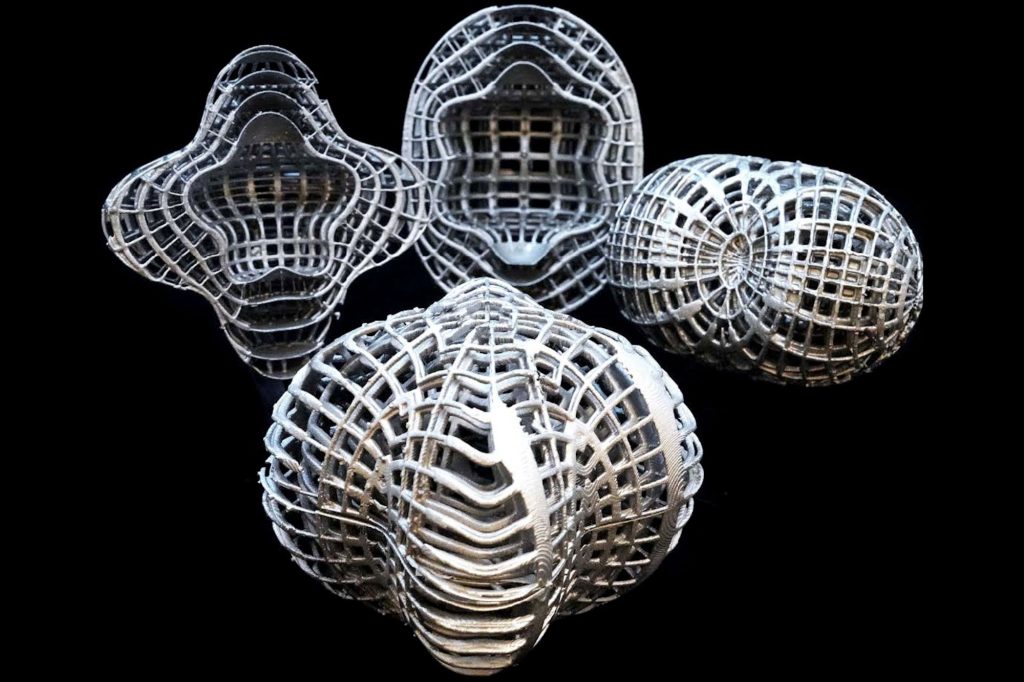
If you point an infrared camera at the wrong object then, up to now, physics has always revealed it.
Heat spreads out from any object that is hotter than its environment and follows the shape of the object emitting it. A team of researchers from the University of Illinois Urbana-Champaign has constructed the first physical 3D thermal cloak, a device that diverts the flow of heat around a concealed object so effectively that it fails to show up on a thermal camera aimed directly at it. The project, headed by Professor Shelly Zhang in collaboration with Ole Sigmund from the Technical University of Denmark, is described in a paper that has been published in Nature Communications.
The cloak appears ordinary, consisting of a thick lattice made from 3D-printed aluminium filled with cast rubber, but the geometry within it is carrying out a very intentional function. Since aluminium conducts heat well while rubber does so poorly, the team is able to control precisely how quickly heat travels through each section of the cloak by altering the ratio and layout of the two materials at every point in the structure. Instead of blocking the heat, which would simply cause the cloaked object to appear as a cold outline rather than a hot one, the lattice smoothly directs the flow of heat around whatever is inside it, so that the surface located directly behind the object gives off heat at the same rate as all the other areas.
In order to test the idea, the researchers put the cloak between a heated area and a cooled one, in a way that simulated the kind of temperature difference a real object could experience, and they inserted within it complex three-dimensional shapes, such as a model of a human head. When viewed with a thermal camera, the cloaked shapes disappeared into the background temperature pattern as if they were not there at all. This is a much more difficult feat than the thermal cloaking experiments carried out so far. The majority of the earlier demonstrations had only worked in two dimensions or in one direction of heat flow and had been unable to hide anything more complicated than a flat panel or a simple block. It was necessary for the lattice to have its internal structure change continuously in all directions, not just in one.
According to a report by SciTechDaily, the fundamental technique involved is known as transformation thermotics, a design method which mathematically handles the flow of heat in a way similar to that of light rays and calculates how the material’s thermal conductivity needs to change from point to point in order to divert the flow around a concealed area. Although the same mathematical principles have been employed for many years in the design of invisibility cloaks for light and sound, it has been much more difficult to create a three-dimensional one for heat using actual, manufacturable materials.
The earliest and most practical application of a 3D thermal cloak is probably not going to be the concealment of people from infrared cameras. Instead, Zhang’s team has identified microchip thermal management as a more immediate use, since the same principle could be employed to divert waste heat away from the sensitive components on a densely packed circuit board, thus protecting them without the need for large heat sinks or fans. In general, electronics packaging could make use of materials that actively direct heat rather than just trying to spread it out evenly. Applications in the fields of defence and security, such as hiding equipment from thermal imaging, come further down the list of proposed uses, and Zhang’s group is currently working on active cloaks - structures that are able to alter their thermal properties in real time rather than having them fixed at the time of manufacturing.
Heat is conducted through a solid substance according to Fourier’s law, a relationship that is well known to all students of physics at the A-level who have studied thermal conduction - the rate at which heat passes through a material being proportional to both its thermal conductivity and the temperature gradient across it. In a normal object the conductivity is about the same everywhere, so heat spreads out by taking the most direct path available, just as water takes the steepest route down a hill. A hot object in a cooler surroundings emits a heat pattern that closely matches its own shape, which is the reason why thermal cameras are so good at detecting people, engines, or any warm object against a cooler background.
Transformation thermotics overcomes this problem by considering the area surrounding the hidden object as a form of curved space for heat, using mathematics that was first developed for bending light around objects in the case of optical cloaking. Rather than allowing heat to take the shortest route through the cloaked area, the theory determines a coordinate transformation which maps the straight paths that exist outside the cloak onto curved paths that go around the concealed object within the cloak, and then works backwards to find what thermal conductivity - varying continuously from one point to another - would cause real heat to follow those curved paths. The outcome is a map of material properties, typically displayed as a smooth, swirling pattern of the required conductivity values, which has to be turned into a form that can be actually constructed.
The actual difficult engineering aspect is the translation, and it is in this stage that the aluminium and rubber lattice proves its value. Since no natural material has a thermal conductivity that changes smoothly and continuously as the mathematics requires, Zhang and Sigmund’s team developed a composite structure by alternating layers of aluminium, which is a good thermal conductor, with cast rubber, which is a poor one, and in doing so arranged the local geometry - that is, the ratio and layout of the two materials at each point - almost as if it were a dial. In some areas there are dense groups of aluminium that enable rapid heat conduction, while in other areas, where there is more rubber, the conduction is slowed down, and because the aluminium framework is 3D printed first and then the rubber is cast into the spaces left behind, the team were able to achieve the smoothly varying conductivity pattern that the transformation thermotics calculation called for, layer by layer, rather than merely approximating it.
Previously, thermal cloaks generally functioned in two dimensions or protected against heat flowing in one direction only, which presents a much simpler design challenge because the necessary conductivity pattern only needs to change across a flat surface. In the case of a three-dimensional cloak that works in all directions, it must redirect heat coming in from any angle, meaning that the internal lattice structure has to meet the transformation equations in three dimensions at the same time, making it a far more difficult computational and manufacturing problem. Moreover, the team had to make sure that the structure was mechanically sound, as a lattice containing numerous rubber-filled gaps is by nature less rigid than a solid block of aluminium, and they had to guarantee that the printed aluminium framework would not deform during the high-temperature casting process used to incorporate the rubber.
The 3D thermal cloak is part of a wider area known as metamaterials, which are materials that have been engineered to possess properties not found in any naturally occurring substance, the result of a careful geometric design rather than relying on unusual chemistry. It serves as a helpful link for students taking materials science or physics at A-level between abstract equations such as Fourier’s law and actual manufactured objects, by demonstrating how a mathematical transformation can be turned into a physical structure through the careful selection of just two very common materials so that the structure behaves in a manner that normal materials cannot. The same kind of transformation-based approach already forms the basis of cloaking devices for light, sound and even ocean waves, and this finding indicates that heat can now be included in that list, at least in the case of objects that are not themselves generating heat.
Zhang’s team is currently working on active thermal cloaks, which are structures capable of altering their internal conductivity pattern in real time rather than having it fixed at the time of manufacturing, so that a single device could conceal objects under varying temperature conditions rather than just in a particular situation. A passive 3D thermal cloak made from aluminium and rubber will not make anything invisible to the unaided eye and it will not overcome all types of thermal sensor. What it does demonstrate is that heat, just as light and sound had before it, can be directed around an object using the appropriate internal geometry, turning a mathematical concept that had existed for decades into something that you can hold in your hands.
Credit via scitechdaily.com
Construction & InfrastructureInnovation


Construction & InfrastructureBreakthroughs