
Energy & EnvironmentInnovation
University of Texas engineers develop innovative wood-based thermal storage material that acts as a passive thermal battery, potentially reducing HVAC energy consumption by storing and releasing heat through phase transitions in building materials

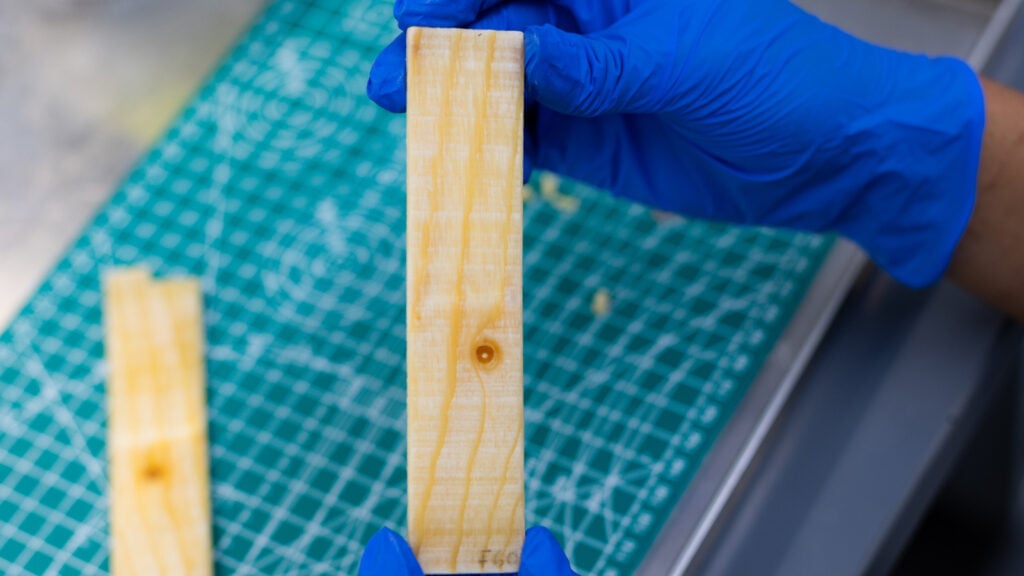
Engineers at the University of Texas at Dallas have developed a new wood-based phase-change material with properties similar to those of a thermal battery. This means that the material can absorb and release heat in response to changes in ambient temperature, thereby providing a passive method for controlling interior temperatures in buildings.
This new wood-based phase-change material will reduce the electrical power required for building heating and cooling, as most electricity used today is consumed in these processes.
 Mechanical engineering professors Dr. Shuang Cui and Dr. Hongbing Lu, and research assistants Gustavo Perruci and Bernadette Magalindan.
When heat is abundant (e.g., during the hot part of the year), the phase-change material absorbs it and stores it until there is less heat available (i.e., during the cold part of the year). At that time, the stored heat is released, maintaining comfortable interior temperatures without using any active mechanical systems.
Assistant Professor Cynthia Cui said that the phase-change material can store heat from the external environment during the hot season and that it prevents the indoor temperature from rising as quickly as it would without the material. Additionally, she believes that if sufficient phase-change material is incorporated into building construction, air conditioning systems can be turned off for extended periods while maintaining a comfortable indoor temperature.
One of the challenges facing engineers working with phase-change materials is that these materials have been found to “leak” when transitioning from the solid to the liquid state. Most previous attempts to contain phase-change materials have involved encapsulating them within a “host” structure. However, those host materials have been poor at storing heat, so most attempts to create phase-change materials have resulted in the host material accounting for a large portion of the final product’s weight.
To address this problem, the engineers developed a host material made of wood. To do this, they removed the lignin from wood substrates. They then chemically treated the remaining wood to remove all lignin, yielding a porous, spongy cellulose matrix with an interconnected network of microchannels and pores. The engineered matrix provided a structural framework for the phase-change materials and retained high porosity to enable effective fluid flow throughout the structure.
Engineering students will recognise the principles underlying the operation of phase-change materials (latent heat storage) from their studies in heat transfer and materials science.
Phase-change materials can store or absorb large amounts of thermal energy during phase transitions while maintaining a relatively constant temperature. Latent heat is stored during a phase transition, such as solid to liquid, at a constant temperature. When a phase-change material approaches its melting point, it absorbs all the thermal energy added to it without an increase in temperature. This thermal energy is used to break intermolecular bonds within the material causing the phase-change material to transform from solid to liquid. As compared to water, a phase-change material can absorb and/or release much larger amounts of thermal energy than water; paraffin wax, a typical phase-change material, can store around 200 kilo-joules/kilogram during melting, which is enough energy to raise the temperature of an equal mass of water by about 50 degrees celsius.
The primary engineering challenges are identifying a suitable phase-change material with a melting point near the operating temperature (the phase-transition temperature should fall between 20 and 26 °C for residential applications) and developing a reliable, safe method for containing and protecting the phase-change material. Texas researchers have developed a solution to the containment issue through a materials-engineering approach. They created a composite material by filling the voids of delignified wood structures with a mixture of a phase-change material and polymer-forming compounds. This resulted in a composite material comprising a constrained liquid phase formed by the phase-change material embedded within a semi-rigid polymer network, mechanically supported by the surrounding wood structure.
At the microscale, material design is important for performance. The wood’s natural cellular structure, which consists of pores typically 10-50 microns in diameter, provides a high surface-area-to-volume ratio that enhances heat-transfer rates within the material. One limitation of phase-change materials is their slow thermal response time; the high surface-area-to-volume ratio of the wood structure helps mitigate this limitation. The polymer-forming compound reacts in place, creating a semi-interpenetrating polymer network that restricts the movement of the liquid phase-change material from escaping from the wood structure while also allowing thermal conductivity pathways to remain open throughout the composite.
From a mechanical engineering standpoint, the composite material must withstand multiple thermal cycles without degrading. Thermal cycling events cause volumetric expansion and contraction in the phase-change material as it melts and solidifies. The porosity of the wood structure accommodates these volume changes, and the semi-rigid nature of the polymer network enables elastic recovery of the material upon cooling. The test results indicated that the material remained structurally intact after more than 1,000 thermal cycling events, corresponding to nearly three years of daily thermal fluctuations.
Using wood as the base material for the composite offers several additional engineering advantages that are independent of its porosity. Due to its anisotropic properties (i.e., different physical properties in the direction parallel vs. perpendicular to the grain of the wood), engineers can tailor the heat-flow paths and resistances through the wood structure. In particular, the wood’s longitudinal channels enable rapid heat conduction along the grain while impeding heat flow perpendicular to it, thereby enabling directional thermal management in various building-related applications.
It is anticipated that the material will last for several years under normal building conditions, as the researchers tested the product and found no evidence of leakage or performance degradation after completing 1,000 cycles of solidification and melting of the phase-change component within the composite. Professor Hongbing Lu, co-author of the study, states that this composite material, which uses a phase-change component, has retained structural integrity through multiple thermal cycling tests – an important consideration for integrating the material into building products.
Mechanical engineering professors Dr. Shuang Cui and Dr. Hongbing Lu, and research assistants Gustavo Perruci and Bernadette Magalindan.
The authors indicate numerous opportunities to use the phase-change composite in building materials. For example, drywall panel manufacturers could incorporate the composite into their wall panels so that the interior surface of buildings can absorb and release heat as needed. A similar application could involve flooring systems that absorb solar radiation during the day and release the stored energy when needed during cooler evening periods. The most promising application of the phase-change composite is as a roofing material, because roofs receive the most sunlight throughout the year and therefore experience the greatest daily temperature variation.
The development of composite materials offers numerous opportunities to address the technical limitations of traditional heating, ventilation, and air conditioning (HVAC) systems used for building climate control. Most conventional HVAC systems respond to temperature changes by consuming substantial electrical energy to heat or cool buildings during peak-demand periods. In contrast, passive thermal storage using phase-change materials could reduce peak electrical demand on HVAC systems, thereby reducing stress on building infrastructure and the electrical grid during extreme weather events.
The economic implications of the phase-change composite depend on the manufacturing costs and integration strategies employed. Although the researchers have not provided estimates of the costs associated with producing the composite, using wood as a base material may yield cost savings relative to other synthetic materials under development for similar applications. However, the removal of lignin from the wood and the subsequent infusion of polymer into the wood pores may require specialised equipment, which could increase the overall costs of producing the composite.
There are still many technical challenges to overcome before the phase-change composite can be commercially viable. The thermal storage capacity of the phase-change composite must compare favourably with that of currently available insulation materials and thermal masses. There is also a need to develop standardised test methods to assess the long-term performance of the composite under varying climates and environmental conditions. Finally, the authors acknowledge significant barriers to incorporating the phase-change composite into existing building codes, construction practices, and quality-control measures during large-scale production.
Future development efforts by the research group will focus on enhancing the thermal storage capacity of the phase-change composite across different climate regions, improving the composite’s manufacturing efficiency, and evaluating its performance in full-scale building applications. If the researchers can overcome the remaining technical challenges, wood-based phase-change materials could provide a sustainable means of reducing the energy required to build and maintain comfortable indoor environments while maintaining or improving occupant comfort.
Credit via https://eandt.theiet.org/2026/02/03/wood-based-material-stores-heat-cut-building-energy-demandeandt.theiet.org
Energy & EnvironmentInnovation
ChemicalsBreakthroughs
Construction & InfrastructureInnovation