Automotive & Transport

Hyperloop technology proposes high-speed ground transportation using a magnetically levitated pod travelling through near-vacuum tubes at speeds exceeding 700 km/h. Elon Musk formalised the modern concept in his 2013 Hyperloop Alpha white paper, proposing a Los Angeles to San Francisco route with 35-minute travel times at estimated costs of $6 billion.[1]

The concept itself traces back over 200 years-George Medhurst proposed pneumatic tube transportation in 1810, and various atmospheric railway attempts failed throughout the 1840s. Musk’s proposal catalysed renewed interest, spawning companies such as Virgin Hyperloop One (2014), Hyperloop Transportation Technologies (2013), and TransPod (2015), as well as numerous academic research programs.
The system theoretically combines magnetic levitation with reduced air resistance in low-pressure tubes, enabling high speeds while consuming less energy than aviation. SpaceX hosted five competition rounds from 2015 to 2019, with Technical University of Munich achieving a student record of 463 km/h before the test track’s removal in 2022.
The hyperloop system requires maintaining pressure at 100 Pascals (Pa)[2]-equivalent to 0.1 millibar or 0.1% of atmospheric pressure-along hundreds of kilometres of tube. This pressure represents conditions found at an altitude of 50 km, creating a 1,000:1 pressure differential between the interior of the tube and the external atmosphere. The tube structure must withstand approximately 10 tonnes per square meter of external crushing force, requiring steel walls 20-25 mm thick with safety factors of 1.5 applied. The Hyperloop Alpha specification proposed $10 million in vacuum pump costs[3] for the 560 km Los Angeles-San Francisco route, though subsequent analyses suggest significant underestimation.
Vacuum maintenance employs two-stage pumping systems: backing pumps reduce the pressure from atmospheric to approximately 1,000 Pa, followed by Roots pumps that achieve the operational pressure. For a 500 km route, the initial pump-down requires 200 vacuum units (each containing three Roots pumps and two backing pumps) to operate for 6 hours, with six units running continuously to compensate for leakage. HyperloopTT’s commercial system positions vacuum units every 10 km along the route, packaged in shipping containers for modular deployment. Roots pumps prove optimal for high-volume flow at low pressures, though turbomolecular pumps operating at 20,000-90,000 RPM may be employed where extremely low pressures are required.
Leakage represents a persistent challenge. Air infiltrates through tube wall outgassing, connection joints, welds, station airlocks, and temperature-induced pressure differentials. The Kantrowitz limit constrains the capsule-to-tube area ratio to 36-47% to prevent airflow choking at sonic velocities. Lower operating pressures reduce aerodynamic drag but increase the pressure differential driving leakage, creating a trade-off between propulsion efficiency and pumping energy requirements. Delft University research suggests optimal pressures of 30-200 Pa depending on tube saturation, with 30 Pa for high-density operations and 200 Pa for lower traffic volumes.
Thermal expansion poses severe structural challenges. A 100 km steel tube experiences longitudinal expansion approaching 50 meters across typical temperature ranges. Solutions include flexible pylon mounting systems allowing lateral slip with damping, telescoping sections at stations (similar to airport jet bridges), and slip joints designed for thermal movement. Pylons spaced every 30-100 meters incorporate adjustable lateral and vertical dampers to absorb length changes while maintaining structural integrity.
Hyperloop designs predominantly employ Electrodynamic Suspension (EDS), a passive magnetic levitation system using repulsive electromagnetic forces. Moving magnets induce eddy currents in conductive tracks, creating opposing magnetic fields that generate levitation without the need for external power. EDS systems maintain levitation gaps of 10-100 mm and operate in inherently stable open-loop configurations, although they cannot levitate at zero speed; therefore, auxiliary wheels are required during departure and arrival.
Electromagnetic Suspension (EMS) offers an alternative using attractive forces between electromagnets and ferromagnetic tracks. EMS maintains smaller gaps of 10-20 mm through active control systems, continuously adjusting the current to prevent instability. The Transrapid maglev in Shanghai utilises EMS, achieving operational speeds of 500 km/h. EMS levitates from standstill but requires complex control systems and consumes more energy than passive alternatives.
Hardt Hyperloop utilises EMS, employing permanent magnets to provide static lift, supplemented by electromagnets for active control and balance. Their system achieves a 15 mm operational air gap with levitation magnets totalling 3,400 kg, distributed across 42 modules of 80 kg each. Power consumption remains negligible-comparable to a light bulb-with a magnetic lift-over-weight ratio of 10:1. Korea Railroad Research Institute developed High-Temperature Superconducting (HTS) magnets capable of 24 cm air gaps-huge compared to conventional systems-targeting 1,200 km/h velocities with magnetic resistance forces below 2 kN.
Propulsion systems employ linear motors-essentially rotary motors that have been “unrolled” into linear configurations. Linear Induction Motors (LIM) induce currents in aluminium reaction plates, generating thrust through electromagnetic interaction. Long-primary configurations place powered stators in the guideway with passive aluminium secondaries on pods, proving more efficient at speeds exceeding 100 km/h despite higher infrastructure costs. Hyperloop Alpha specified a 15-meter aluminium rotor blade, 0.45 meters tall and 50 mm thick, with 20 mm air gaps[4] and stators mounted over 4 km acceleration zones, generating a 720 lbs (3,200 N) force.
Linear Synchronous Motors (LSMs) achieve higher efficiency by synchronising mechanical motion with the travel of the magnetic field. Korea’s HTS-LSM design utilises air-core armatures to avoid magnetic saturation, with power supplies delivering approximately 10 MVA per propulsion section. LSM systems prove optimal for sustained high speeds exceeding 1,000 km/h, though they require precise real-time position sensing and complex control systems. Regenerative braking captures kinetic energy during deceleration, storing it in trackside battery arrays for subsequent vehicle acceleration, improving overall system efficiency.
Modern hyperloop pod designs typically range from 24 to 30 meters in length, with diameters of 2.5 to 2.7 meters, accommodating 40 to 50 passengers. Hardt Hyperloop’s 24-meter vehicle weighs a total of 25,000 kg, comprising an 8,600 kg payload and cabin, a 3,200 kg main body structure, 10,000 kg of tractive systems (including levitation, propulsion, guidance, and emergency braking), and 3,200 kg of batteries. Carbon fibre composite construction dominates-HyperloopTT’s “Vibranium” dual-layer innovative composite provides eight times the strength of aluminium at five times the weight of steel, with embedded sensors monitoring structural integrity in real-time.
The pod functions as a pressure vessel, maintaining atmospheric pressure internally while travelling through a near-vacuum, creating a 1,000:1 pressure differential. Cylindrical monocoque structures optimise pressure containment, with designs following aircraft fuselage principles. Aluminium 6061-T6 and pre-impregnated woven carbon fibre (TenCate 8020 epoxy-based material) provide high stiffness-to-weight ratios. Delft Hyperloop’s bidirectional, symmetric design eliminates turnaround requirements, with elongated “tail-tail” teardrop profiles that reduce drag by 30% compared to cylindrical configurations.
Safety systems employ multiple redundant braking mechanisms to ensure reliability and safety. Primary regenerative braking, achieved through the propulsion system, provides a nominal deceleration of 1.5 m/s². Hardt’s Emergency Braking System (EBS) utilises eddy current braking, which involves passive magnets deployed near conductive tracks, generating up to 0.8g deceleration without requiring power. Emergency braking distances scale dramatically with speed: 75 meters at 100 km/h, 2,557 meters at 700 km/h, and 5,100 meters at 1,000 km/h. Friction brakes serve as a fail-safe backup, utilising compression springs to provide normal force.
Decompression emergencies require a rapid response. Systems must re-pressurise to the Armstrong limit (0.063 bar) within 4 seconds to prevent loss of consciousness and reach a breathable atmosphere (0.6 bar) in 35-40 seconds. Segmentation doors isolate affected tube sections in 30 seconds, with release valves spaced 30 per kilometre. Emergency oxygen masks deploy automatically when pressure drops below safe levels. Fire suppression utilises Halon gas systems in battery compartments, smoke detectors throughout protected areas, and flame-retardant materials that meet EN 45545-2:2016 standards. Evacuation procedures combine internal safe havens with in-tube evacuation to emergency exits positioned every 500 meters, following rapid section re-pressurisation.
Above-ground elevated construction costs approximately €38 million per kilometre ($61 million per mile), comprising €12.9 million for LSM propulsion systems, €8.6 million for 3.5-meter diameter steel tubes with 25 mm thickness, and €5.0 million for construction labour. Concrete support pylons spaced every 30-100 meters provide structural support while accommodating thermal expansion through flexible mounting systems. Underground tunnel construction ranges €60-70 million per kilometre ($97-113 million per mile), including tunnel boring, emergency shafts, and portals. Realistic total project costs, including land acquisition, reach $116-256 million per mile-comparable to or exceeding high-speed rail construction costs.
The original Musk proposal costed the Los Angeles-San Francisco route at about $6 billion,[1] but Virgin Hyperloop One’s 2016 estimates revised this to $84-121 million per mile, yielding total project costs of $44-63 billion. California High-Speed Rail currently projects costs of $154-200 million per mile, with total expenses escalating from an original $40 billion to $105-128 billion for a 520-mile route. French TGV construction costs €18-26 million per kilometre, while China achieves $17-21 million per kilometre through state-coordinated programs. The UK’s HS2 reaches $339 million per kilometre ($212 million per mile).
Seismic considerations prove particularly challenging in earthquake-prone regions. California’s route requires seismic dampers similar to those used on the Dumbarton Bridge bearings, which cost $90,000 each. With two bearings per pylon, this could add $4 billion to project costs. Precision alignment proves critical: at speeds exceeding 700 mph, even minor track deviations can create hazardous buffeting. Curve radius requirements constrain routing-maintaining 4.5 m/s² lateral acceleration at 735 km/h demands a minimum curve radius of 25.5 km, far exceeding the TGV’s 4 km requirement.
Right-of-way acquisition remains contentious, despite the hyperloop’s smaller 4-meter footprint compared to the 25-meter high-speed rail requirements. The elevated profile theoretically enables highway median construction; however, urban areas still require extensive tunnelling. Station design incorporates multiple airlocks for pressure transitions, automated loading systems, and control centres-with a proposed capacity of 3,600 passengers per hour requiring sophisticated coordination. Vacuum pump installations every 1.6 km require housing, access roads, power supply, and maintenance infrastructure, with each installation costing approximately €180,000.
China’s state-backed CASIC T-Flight achieved the highest hyperloop test speed of 387 mph (623 km/h) in February 2024 at its 2 km Datong test facility, surpassing Japan’s record for a superconducting maglev. The facility, completed in November 2023, represents the world’s longest full-scale hyperloop track, with surface flatness tolerances of 0.3 mm. CASIC aims to extend its 60 km track by 2025 for testing at 1,000 km/h, with ultimate goals of achieving 2,000 km/h (supersonic) by 2030.
The European Hyperloop Centre in Veendam, Netherlands, commenced operations in 2024 with a 420-meter test track[5] featuring 2.5-meter-diameter tubes and unique lane-switching technology. Hardt Hyperloop conducted its first tests in September 2024, achieving 30 km/h over 90 meters with the successful integration of magnetic levitation, guidance, and propulsion, while maintaining a pressure of one millibar. By late 2024, Hardt reached 85 km/h performing lane-switching manoeuvres-a European speed record-across over 750 test missions. The €30 million facility receives funding from the Dutch Government (€7.5 million) and the European Commission (€15 million), hosting over 20 partner organisations, including POSCO, Tata Steel Netherlands, and research institutions.[6]
Swisspod Technologies achieved a distance record in June 2024: their LIMITLESS project completed 11.8 km on a 1:12 scaled circular track, equivalent to 141.6 km at full scale. The scaled prototype reached 40.7 km/h (equivalent to 488.2 km/h full-scale) at a 50 millibar pressure, following 82 rigorous tests. Swisspod’s Colorado facility-a full-scale 1.6 km track in Pueblo-installed its first tubes in November 2024, with completion targeted for late 2025.
Virgin Hyperloop One ceased operations in December 2023 after raising $450 million, having conducted only one human passenger test reaching 107 mph (172 km/h) in November 2020-far below promised airline speeds. The company failed to secure any commercial contracts, as the majority stakeholder, DP World, acquired the intellectual property. HyperloopTT’s €800 million Italy project (Venice-Padua) signed feasibility study contracts in January 2024; however, the company faces financial difficulties, including unpaid employee salaries. Student competitions continue to advance technology: Delft Hyperloop became the first student team to test on EHC’s 420-meter track in July 2025, winning overall awards at European Hyperloop Week.
Hyperloop proponents claim that operating costs are comparable to or lower than those of high-speed rail, but comprehensive economic analyses reveal substantial challenges. TU Delft researchers determined hyperloop fares must exceed €0.30 per passenger-kilometre for profitability, compared to €0.174/p-km for high-speed rail and €0.183/p-km for air travel. Original $20 ticket claims for Los Angeles-San Francisco prove unrealistic-transportation economists calculate $1,000+ tickets would be required to achieve 6% returns on $100 billion infrastructure investment.
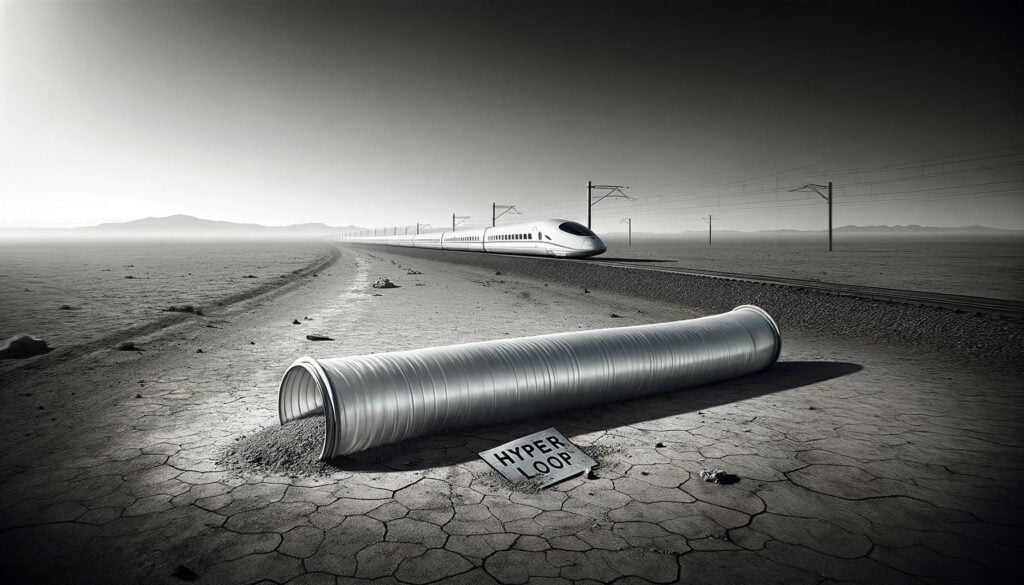
Capacity limitations severely impact economics. Hyperloop systems transport 840-3,600 passengers per hour compared to high-speed rail’s 15,000-20,000 passengers per hour. Each pod carries only 28-50 passengers, versus 400-800 for HSR trains, which fundamentally constrains revenue generation. Academic studies comparing equivalent capacities found that HSR and maglev exhibit lower total energy consumption and CO₂ emissions than hyperloop systems, which provide equivalent transport capacity through multiple pods.
Energy consumption presents mixed results. Propulsion energy remains low due to magnetic levitation and reduced air resistance, but vacuum pump operation requires substantial continuous power. For freight applications, the Department of Energy analysis concluded that the hyperloop proves 8 times less efficient than water/rail transport and 3 times less efficient than trucks. Life-cycle assessments suggest <8 g CO₂/pkm with renewable electricity-comparable to high-speed rail-but dependent on clean energy sources.
Construction cost escalation undermines economic projections. Poland’s network estimates exceed €46 billion for a 3,000-30,000 km network. The Great Lakes Hyperloop (Chicago-Cleveland-Pittsburgh) project is estimated to cost $25-30 billion, with a claimed benefit-cost ratio of 2.20. However, ticket prices of $33-60 (two-thirds of Amtrak prices) may prove optimistic, given the high infrastructure costs. No commercial hyperloop system exists to validate economic models, and private investment remains essentially absent despite over a decade of development efforts.
Transportation experts project commercial hyperloop deployment remains decades away, if achievable. Twelve years after Musk’s 2013 proposal, no operational systems have been established, and no commercial contracts have been secured. Virgin Hyperloop’s closure exemplifies the gulf between promotional claims and engineering reality-$450 million invested yielded only a 107 mph test before shutdown.
The 2022 International Maglev Board survey found that transportation experts worldwide are rejecting hyperloop concepts, primarily due to underestimated operational complexity, safety challenges, and high costs. Professor Vaclav Smil’s historical analysis notes that 200+ years of similar pneumatic tube proposals have consistently failed, concluding that the hyperloop represents “not even a half-baked idea.” Dallas-Fort Worth’s 2022 decision to pursue proven high-speed rail over hyperloop reflects the regulatory impossibility of the latter, as no safety standards, certification centres, or full-scale models exist for regulatory approval.
Technical barriers include maintaining a vacuum over hundreds of kilometres (300-meter thermal expansion for 600 km tubes), ensuring passenger safety at extreme speeds (kinetic energy equivalent to 75-200 kg TNT), and managing emergency scenarios. Economic barriers encompass construction costs that are 10 times the original estimates and operating costs, excluding critical items. Regulatory barriers involve a complete absence of certification frameworks, which prevents effective environmental review processes. Most experts suggest focusing resources on proven high-speed rail technology rather than speculative hyperloop systems.
Credit More on hyperloops
Hyperloop could transport people, vehicles, and freight between Los Angeles and San Francisco in 35 minutes. Transporting 7.4 million people each way and amortizing the cost of $6 billion over 20 years gives a ticket price of $20
Internet Archive copy of the white paper as published on spacex.com (August 2013).
Checked 14 October 2026
operating pressure of 100 Pascals, which reduces the drag force of the air by
Internet Archive copy of the white paper as published on spacex.com (August 2013).
Checked 14 October 2026
The expected cost of all required vacuum pumps is expected to be no more than $10 million USD.
Internet Archive copy of the white paper as published on spacex.com (August 2013).
Checked 14 October 2026
The rotor of the linear accelerators is very simple – an aluminum blade 49 ft (15 m) long, 1.5 ft (0.45 m) tall, and 2 in. (50 mm) thick.
Internet Archive copy of the white paper as published on spacex.com (August 2013). The next paragraph gives the 0.8 in. (20 mm) gap on each side.
Checked 14 October 2026
European Hyperloop Center Opens Up For The First Test
Veendam, 27th of March – The European Hyperloop Center (EHC) announces the completion of its hyperloop test infrastructure and opens up for the first tests. This facility, featuring a 420-meter hyperloop test tube, can demonstrate all essential hyperloop technologies including a full lane switch.
Checked 14 October 2026
European Hyperloop Center Opens Up For The First Test
The hyperloop pipes are made from steel developed by POSCO (KR) in collaboration with Tata Steel (NL)
Checked 14 October 2026
Automotive & Transport
Construction & Infrastructure
Automotive & Transport
Automotive & Transport