Voyager 2: NASA's Succeed in Restoring Contact with the Farthest Spacecraft
A mistaken command in July 2023 tilted the antenna on Voyager 2 by 2 degrees, away from Earth. NASA sent a powerful command from Australia and has now restored full contact with the spacecraft.
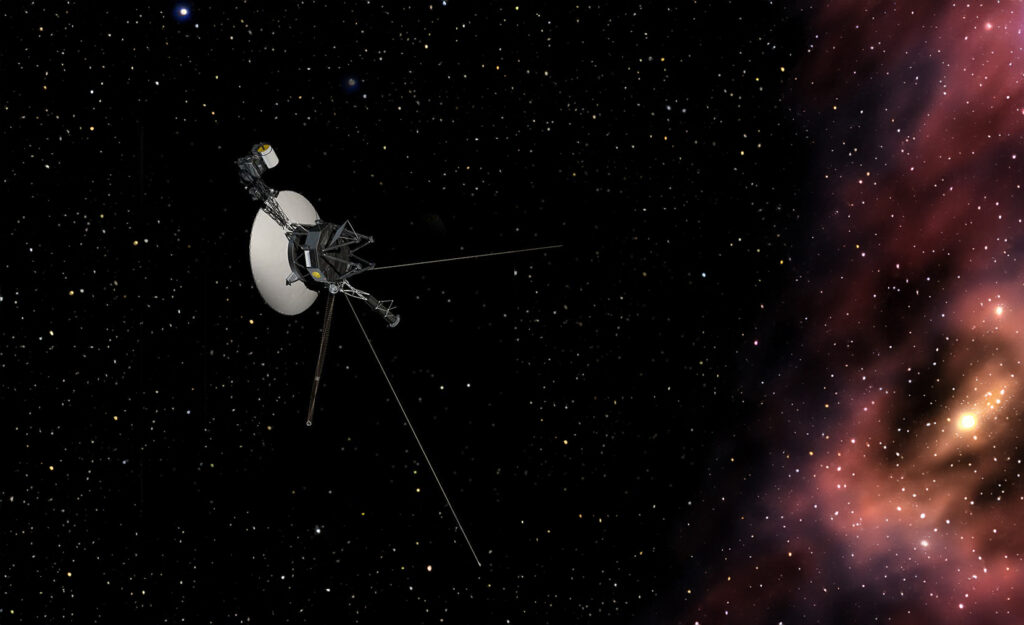
Key points
TL;DR of the Article:
- Voyager 2, a spacecraft launched in 1977, recently faced a communication issue due to an erroneous command that tilted its antenna away from Earth.
- NASA's Jet Propulsion Laboratory team devised a plan to send a powerful instruction, an "interstellar shout," to reorient Voyager 2's antenna back towards Earth.
- Despite the vast distance of over 12 billion miles, the command successfully reached Voyager 2, and the spacecraft began returning data, indicating it was operating normally.
- Voyager 2 continues its journey in space, and as long as its power holds, it could continue to operate until the 50th anniversary of its launch in 2027.
In the vast expanse of space, billions of miles away from Earth, lies Voyager 2, a spacecraft that has been on a remarkable journey since its launch in 1977.
Last month an incorrect command sent from Earth caused the spacecraft’s antenna to tilt away, severing the communication link with its home planet. Today NASA, undeterred by the vast distances and complex challenges, have successfully restored contact with Voyager 2, ensuring the continuation of its extraordinary mission.
Voyager 2 Communication Issue
In July 2023, a routine command sequence inadvertently led to a significant problem communicating with the craft.
The command, issued by a technician at NASA, caused Voyager 2’s antenna to tilt 2 degrees from Earth,[1][2] disrupting the vital communication link between the spacecraft and NASA’s Deep Space Network.
This network, an array of giant radio antennas spread worldwide, is the primary method for sending commands to and receiving data from distant spacecraft like Voyager 2.
The unintended antenna tilt meant that Voyager 2 could no longer accept orders or send back data, leaving it adrift in the interstellar void.
Since then, NASA’s Jet Propulsion Laboratory team has sprung into action. They devised a plan to send an “interstellar shout” – a powerful instruction aimed at reorienting Voyager 2’s antenna back towards Earth.
This command was sent using the highest-power transmitter at a giant radio dish antenna in Australia.[3][4] Given the vast distance between Earth and Voyager 2 – over 12 billion miles – it took more than 18 hours for the command to reach the spacecraft and another 18 hours to receive a response.[5][6]
After a tense wait, the team’s efforts paid off. Voyager 2 began returning data, indicating that it was operating normally and on its planned trajectory.[7][8]
The successful restoration of communication with Voyager 2 was met with a collective sigh of relief from the team at NASA. The spacecraft, once again, began sending back valuable data from the depths of interstellar space.
This incident underscored the resilience of the Voyager spacecraft and the ingenuity of the teams that support them. Despite the challenges posed by the vast distances and the ageing technology of the spacecraft, the Voyager team demonstrated that they could overcome significant obstacles to keep the mission going.
Voyager 2: A Journey Through the Solar System
Voyager 2 has been on an extraordinary journey since 1977, and it is the only spacecraft to have visited all four gas giant planets in our solar system: Jupiter, Saturn, Uranus, and Neptune.[9] Voyager 2’s mission was designed to take advantage of a rare planetary alignment, enabling it to study the outer solar system up close.
Voyager 2 and its twin Voyager 1 embarked on a grand solar system tour in 1977, with Voyager 2 blasting off on August 20, 1977.[10] The mission was designed to take advantage of a rare planetary alignment that occurs once every 176 years.[11] The spacecraft has made groundbreaking discoveries and have sent back invaluable data about the outer planets and their moons.
Voyager 2 was launched from Cape Canaveral, Florida, on a Titan IIIE-Centaur rocket.[12][13] Weighing 1,592 pounds (721.9 kilograms),[14] the spacecraft was equipped with a suite of scientific instruments, including an imaging science system, ultraviolet spectrometer, infrared interferometer spectrometer, planetary radio astronomy experiment, photopolarimeter, triaxial fluxgate magnetometer, plasma spectrometer, low-energy charged particles experiment, plasma waves experiment, cosmic ray telescope, and a radio science system.
The Grand Tour
Voyager 2’s trajectory was carefully planned, allowing it to fly by all four gas giant planets.
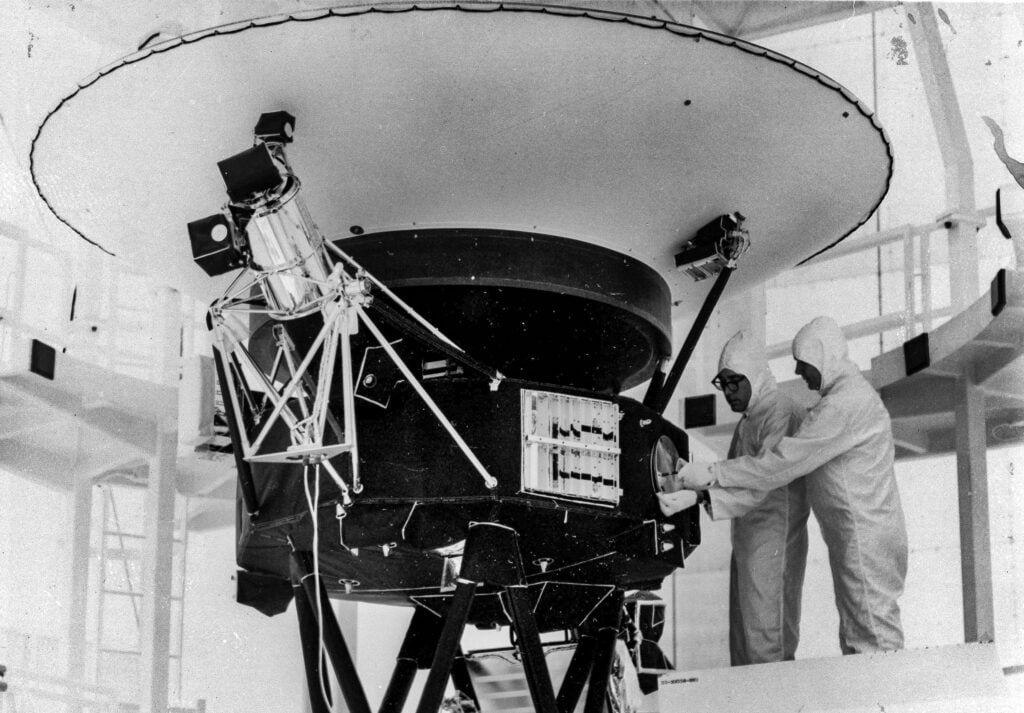 August. 4, 1977, photo provided by NASA, the “Sounds of Earth” record is mounted on the Voyager 2 spacecraft in the Safe-1 Building at the Kennedy Space Center. (NASA, File)
It made its closest approach to Jupiter on July 9, 1979,[15] providing new data on the planet’s clouds, newly discovered moons, and ring system. The spacecraft then sped to Saturn, which flew closer to the world than any previous mission and provided more detailed images of Saturn’s rings and moons.
Voyager 2’s journey continued to Uranus, making it the first human-made object to fly past the planet.
Voyager 2 discovered ten new moons, two unique rings, and a magnetic field tilted at 55 degrees off-axis and off-centre during its flyby.[16][17] The spacecraft also found evidence of a boiling ocean of water some 800 kilometres below the top cloud surface.[18]
The final stop in the grand tour was Neptune. The spacecraft discovered five moons, four rings, and a “Great Dark Spot” during its flyby.[19] Voyager 2 also revealed that Neptune’s largest moon, Triton, was the coldest known planetary body in the solar system[20] and had a nitrogen ice “volcano” on its surface.
After its encounter with Neptune, Voyager 2 made its way to interstellar space, where its twin spacecraft, Voyager 1, had resided since August 2012.[21][22]
On November 5, 2018, Voyager 2 officially entered interstellar space,[23][24] making it the second human-made object to do so. Despite being in operation since 1977, Voyager 2 continues to send back data from the five science instruments still in operation.[25] The data received from Voyager 2 should continue until at least 2026.[26]
Voyager 2’s journey has given humanity an unprecedented view of the outer solar system. The data and images it has sent back have greatly expanded our understanding of the gas giant planets and their moons. Even as it travels through interstellar space, Voyager 2 continues contributing to our knowledge of the universe. Its mission, originally planned to last for five years,[27] has turned into a voyage of over four decades and counting, making Voyager 2 one of the most successful and enduring feats of interplanetary exploration.
The Future of Voyager 2
Looking ahead, Voyager 2 continues its journey, moving farther away from Earth but still connected to its home planet. As long as its plutonium power source holds, Voyager 2 could continue to operate until the 50th anniversary of its launch in 2027 and possibly beyond.
The Voyager missions, including Voyager 2’s ongoing journey, represent a significant milestone in our space exploration. They have expanded our understanding of the solar system and pushed the boundaries of human exploration. As Voyager 2 continues its journey, it carries the story of human ingenuity and the thirst for knowledge, a testament to our desire to explore and understand the universe.
Credit via bbc.co.uk
Sources
27 sources
Mission Update: Voyager 2 Communications Pause
caused the antenna to point 2 degrees away from Earth.
Checked 26 November 2026
NASA regains full contact with Voyager 2
The Jet Propulsion Laboratory lost contact with Voyager 2 on July 21 after mistakenly pointing its antenna 2 degrees away from Earth.
Checked 26 November 2026
NASA restores contact with Voyager 2 spacecraft after mistake led to weeks of silence
using the highest powered transmitter at the huge radio dish antenna in Australia.
Checked 26 November 2026
Mission Update: Voyager 2 Communications Pause
Deep Space Network facility in Canberra, Australia, sent the equivalent of an interstellar
Checked 26 November 2026
Mission Update: Voyager 2 Communications Pause
With a one-way light time of 18.5 hours for the command to reach Voyager,
Checked 26 November 2026
NASA restores contact with Voyager 2 spacecraft after mistake led to weeks of silence
It took more than 18 hours for the command to reach Voyager 2
Checked 26 November 2026
Mission Update: Voyager 2 Communications Pause
At 12:29 a.m. EDT on Aug. 4, 2023, the spacecraft began returning science and telemetry data,
Checked 26 November 2026
NASA regains full contact with Voyager 2
NASA said it resumed full communications with the Voyager 2 on Friday after almost two weeks of silence from the interstellar spacecraft.
Checked 26 November 2026
Voyager 2: First To Visit All Four Giants
Voyager 2 is the only spacecraft to study all four of the solar system's giant planets at close range.
Checked 26 November 2026
45 Years Ago: Voyager 2 Begins Its Epic Journey to the Outer Planets and Beyond
Voyager 2 lifted off on Aug. 20, 1977.
Checked 26 November 2026
Then There Were Two: Voyager 2 Reaches Interstellar Space
rare alignment of the outer planets that only occurs once every 176 years
Checked 26 November 2026
45 Years Ago: Voyager 2 Begins Its Epic Journey to the Outer Planets and Beyond
atop a Titan IIIE-Centaur rocket
Checked 26 November 2026
Voyager 2: First To Visit All Four Giants
Cape Canaveral, Fla. / Launch Complex 41.
Checked 26 November 2026
Voyager 2: First To Visit All Four Giants
1,592 pounds (721.9 kilograms)
Checked 26 November 2026
Voyager 2: First To Visit All Four Giants
Voyager 2's closest encounter to Jupiter was at 22:29 UT July 9, 1979, at a range of about 400,785 miles
Checked 26 November 2026
Voyager 2: First To Visit All Four Giants
During its flyby, Voyager 2 discovered 10 new moons
Checked 26 November 2026
Voyager 2: First To Visit All Four Giants
a magnetic field tilted at 55 degrees off-axis and off-center.
Checked 26 November 2026
Voyager 2: First To Visit All Four Giants
found evidence of a boiling ocean of water some 497 miles (800 kilometers) below the top cloud surface.
Checked 26 November 2026
Voyager 2: First To Visit All Four Giants
At Neptune, Voyager 2 discovered five moons, four rings, and a
Checked 26 November 2026
Voyager 2: First To Visit All Four Giants
revealing the coldest known planetary body in the solar system
Checked 26 November 2026
NASA Spacecraft Embarks on Historic Journey Into Interstellar Space
determined Voyager 1 first entered interstellar space in August 2012
Checked 26 November 2026
In August 2012, Voyager 1 made the historic entry into interstellar space
Checked 26 November 2026
NASA’s Voyager 2 Probe Enters Interstellar Space
mission scientists determined the probe crossed the outer edge of the heliosphere on Nov. 5.
Checked 26 November 2026
took it to interstellar space on November 5, 2018
Checked 26 November 2026
NASA’s Voyager Will Do More Science With New Power Strategy
using five science instruments to study interstellar space
Checked 26 November 2026
NASA’s Voyager Will Do More Science With New Power Strategy
postpone shutting down a science instrument until 2026, rather than this year.
Checked 26 November 2026
NASA’s Voyager 2 Probe Enters Interstellar Space
The spacecraft were built to last five years.
Checked 26 November 2026