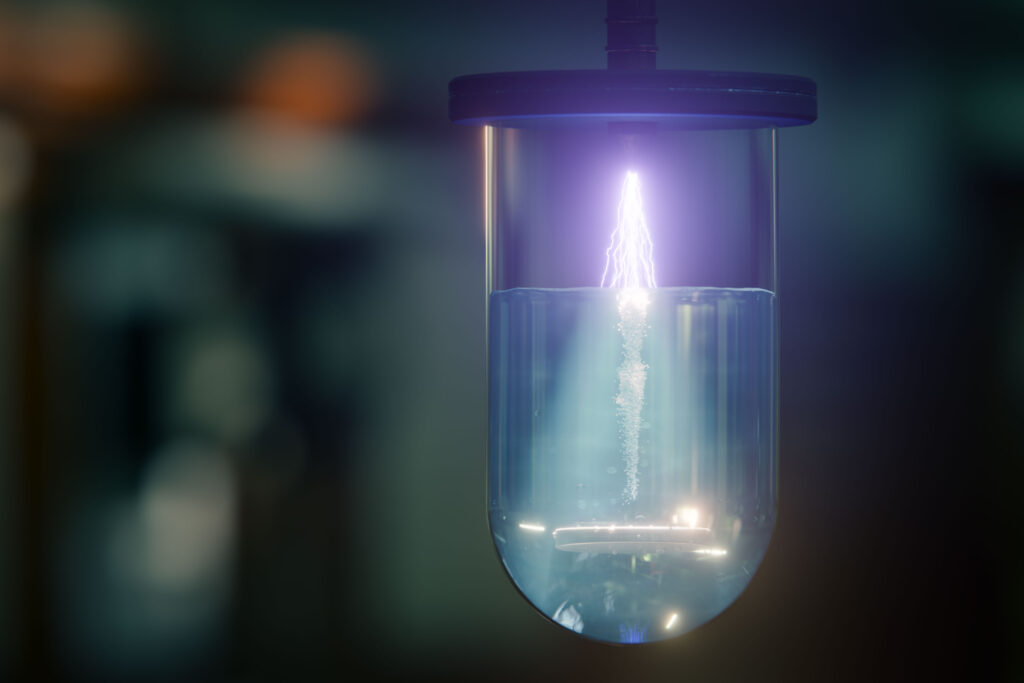
Sodium-Ion Battery Breakthrough: Water Retention Doubles Capacity While Enabling Seawater Desalination
University of Surrey engineers discover that keeping water in sodium-ion batteries nearly doubles charge storage capacity and enables desalination, challenging conventional battery engineering and offering sustainable alternatives to lithium-ion technology.
Key points
- Engineers at the University of Surrey found that retaining water in sodium-ion battery materials doubles charge storage capacity instead of degrading performance
- Water-containing sodium vanadium oxide (NVOH) maintained stability over 400 charge cycles with faster charging rates
- The material can simultaneously store energy and desalinate seawater by removing sodium and chloride ions
- Water molecules create "pillaring" between crystal layers, allowing better sodium ion movement and adding pseudocapacitance storage
- Manufacturing could be simplified without expensive moisture control, potentially reducing costs by 30%
- Challenges remain in scaling production, achieving lithium-ion energy density levels, and long-term cycle stability
- Technology could serve grid storage and coastal renewable energy applications where cost matters more than energy density
Engineers at the University of Surrey have discovered that leaving water inside sodium-ion battery components, rather than removing it as standard practice dictates, nearly doubles their charge storage capacity while enabling the desalination of seawater. The finding challenges decades of conventional battery engineering wisdom and could accelerate the development of sodium-ion technology as a sustainable alternative to lithium-ion systems.
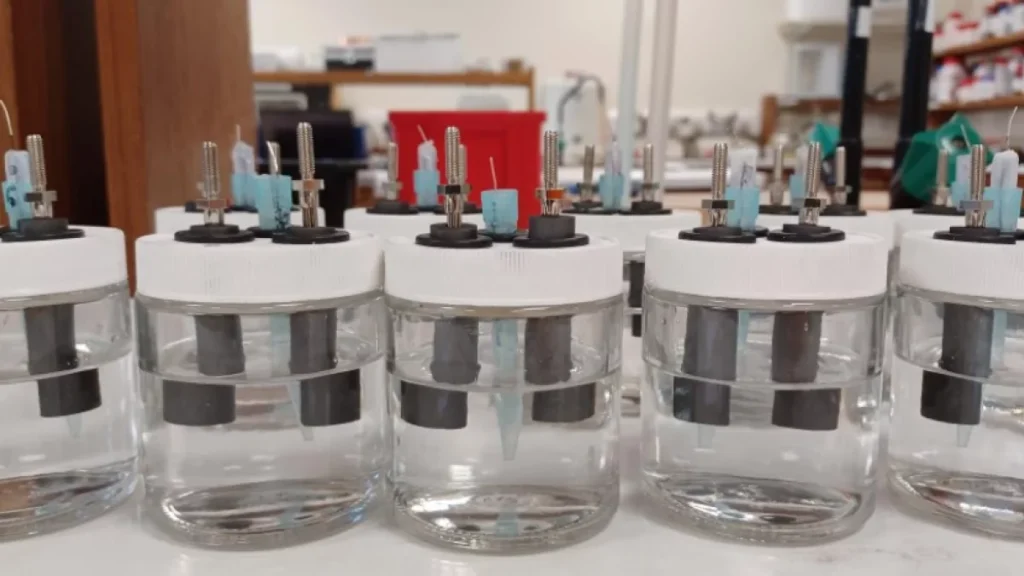
The breakthrough centres on sodium vanadium oxide[1], a material that engineers have used in battery research for years. Traditional processing methods involve heating the material to remove naturally occurring water molecules[2], based on the assumption that water degrades battery performance. The Surrey team decided to test this assumption by comparing the performance of water-containing nanostructured sodium vanadate hydrate (NVOH) with that of its dried counterpart.
Their results showed that the “wet” NVOH material stored almost twice as much charge as typical sodium-ion cathode materials[3] while maintaining stability over 400 charge-discharge cycles[4]. The material also demonstrated faster charging rates than conventional sodium-ion components[4], addressing one of the key limitations that has prevented wider adoption of sodium-based battery technology.
Engineering Applications Beyond Energy Storage
The engineering implications extend beyond improved battery performance. When the research team tested NVOH in saltwater environments, they observed that the material continued functioning effectively while extracting sodium ions from the solution. Paired with a graphite electrode that removes chloride ions[5], the system performs electrochemical desalination-essentially converting seawater into freshwater while storing energy.
This dual functionality opens new engineering possibilities for coastal energy storage facilities and remote desalination systems. If the technology proves scalable, engineers could design battery systems that utilise seawater as a free and abundant electrolyte, while producing fresh water as a byproduct. Such systems would address two critical infrastructure challenges simultaneously: renewable energy storage and freshwater scarcity.
Understanding the Engineering Behind Water-Enhanced Batteries
The performance improvement in water-containing NVOH relates to fundamental electrochemical engineering principles that students encounter in materials science and chemical engineering courses. To understand why water helps rather than hinders, engineers need to examine the material’s crystal structure and ion transport mechanisms.
In traditional lithium-ion batteries, lithium ions move between the cathode and anode through an electrolyte during charging and discharging. The cathode material must have a crystal structure that allows these ions to insert and extract efficiently-a process called intercalation. Engineers typically design these structures with specific spacing between atomic layers to accommodate ion movement.
The sodium vanadium oxide structure contains layers of vanadium and oxygen atoms arranged in sheets. When water molecules remain in the structure, they create what engineers call “pillaring”-the water molecules prop open spaces between the layers, similar to how columns support a parking garage. This increased spacing allows sodium ions, which are larger than lithium ions, to move more freely through the material.
The water molecules also contribute to charge storage through a phenomenon called pseudocapacitance. Unlike traditional battery storage, where ions physically insert into the crystal structure, pseudocapacitance involves fast surface reactions that store charge. The water molecules facilitate these surface reactions by providing additional sites where sodium ions can interact with the material. This dual storage mechanism-intercalation plus pseudocapacitance-explains why the wet material stores nearly twice as much charge.
From a materials engineering perspective, the stability over 400 cycles suggests that the water molecules are structurally bound rather than loosely associated. Engineers call this “structural water” or “crystal water,” which becomes part of the material’s fundamental architecture. The challenge previous engineers faced was distinguishing between beneficial structural water and problematic free water that could cause short circuits or corrosion.
The desalination capability demonstrates another engineering principle: selective ion extraction. When NVOH operates in seawater, it preferentially removes sodium ions while the graphite counter-electrode removes chloride ions. This selectivity stems from the material’s crystal structure, which features channels specifically sized for sodium ions. Engineers can tune this selectivity by modifying the interlayer spacing, potentially creating materials optimised for removing specific contaminants from water.
For engineering students, this discovery illustrates how challenging assumptions can lead to breakthroughs. The standard practice of removing water from battery materials made sense based on experience with other systems where water causes degradation. However, the Surrey team’s systematic approach-testing both dried and hydrated versions under controlled conditions-revealed that context matters. What works for one material system may not apply universally, highlighting the importance of experimental validation in engineering design.
The manufacturing implications could significantly reduce production costs for sodium-ion batteries. Current lithium-ion battery production requires careful control of the atmosphere to prevent moisture exposure, adding complexity and expense to manufacturing facilities. If sodium-ion batteries can tolerate or even benefit from the presence of water, engineers could simplify production processes and reduce facility requirements.
The abundance of sodium compared to lithium addresses another engineering challenge: material sourcing. Lithium extraction requires either hard rock mining or evaporation ponds, both of which are environmentally intensive processes concentrated in specific geographic regions. Sodium, by contrast, exists abundantly in seawater and underground deposits worldwide. Engineers estimate that switching from lithium to sodium could reduce raw material costs by up to 30 per cent while improving supply chain stability.
Temperature performance represents another potential advantage. Lithium-ion batteries suffer capacity losses at low temperatures because the electrolyte becomes viscous, slowing ion movement. The presence of water in NVOH may provide better low-temperature performance, although engineers require additional testing to confirm this hypothesis. If validated, sodium-ion batteries could prove superior for cold-climate applications where current battery technology struggles to perform.
Challenges Ahead for Commercialisation
Despite these promising results, several engineering challenges remain before commercial deployment can occur. The energy density of sodium-ion batteries, even with the NVOH improvement, remains lower than that of lithium-ion systems. Engineers measure energy density in watt-hours per kilogram, and current sodium-ion technology achieves approximately 150 Wh/kg compared to 250 Wh/kg for lithium-ion batteries. While the NVOH material improves charge storage capacity, system-level energy density depends on multiple components.
Scale-up from laboratory to industrial production presents another challenge. The Surrey team produced NVOH using standard laboratory synthesis methods; however, commercial battery production requires large quantities of material with consistent properties. Engineers must develop quality control methods to ensure uniform water content across large batches, as variations in water content can affect battery performance and reliability.
The long-term stability beyond 400 cycles needs verification for commercial applications. Electric vehicle batteries typically require 1,000 to 2,000 cycles to maintain an 80 per cent capacity. Grid storage systems need even longer lifespans, often exceeding 5,000 cycles. Engineers must conduct accelerated ageing tests to predict how NVOH performs over the years of operation.
Integration with existing battery management systems poses additional complexity. Current systems are designed for water-free operation and incorporate multiple safeguards against moisture ingress. Engineers would need to redesign these systems to accommodate water-containing materials while preventing unwanted reactions with other battery components.
The desalination capability, while intriguing, requires separate optimisation from energy storage performance. The ideal conditions for maximum charge storage differ from those for efficient salt removal. Engineers must determine whether a single system can effectively perform both functions or if specialised designs better serve each application.
Should these challenges prove surmountable, sodium-ion batteries could complement rather than replace lithium-ion technology. Engineers envision sodium-ion systems serving applications where cost matters more than energy density, such as grid-scale renewable energy storage or backup power systems. The added desalination capability could make them particularly valuable for coastal renewable energy installations, where they could store solar or wind energy while providing fresh water for local communities.
Credit via interestingengineering.com
Sources
5 sources
Sodium-ion battery breakthrough could power greener energy and desalinate seawater
sodium vanadium oxide can perform significantly better when the water it naturally contains is not removed.
Checked 14 October 2026
Sodium-ion battery breakthrough could power greener energy and desalinate seawater
Our results were completely unexpected. Sodium vanadium oxide has been around for years, and people usually heat-treat it to remove the water because it's thought to cause problems.
Checked 14 October 2026
Sodium-ion battery breakthrough could power greener energy and desalinate seawater
the 'wet' version of the material could hold almost twice as much charge as typical sodium-ion materials
Checked 14 October 2026
Sodium-ion battery breakthrough could power greener energy and desalinate seawater
charging much faster and remaining stable for more than 400 charge cycles.
Checked 14 October 2026
Sodium-ion battery breakthrough could power greener energy and desalinate seawater
it not only continued to function effectively but also removed sodium from the solution while a graphite electrode extracted chloride – a process known as electrochemical desalination.
Checked 14 October 2026
Share
Related stories
All Chemicals
Energy & EnvironmentInnovation
Second-Life EV Battery Storage Arrives as Rivian and Redwood Build a 10 MWh System from Old Car Batteries
Energy & Environment
EDF Renewables Boosts UK’s Battery Storage Capacity: A Deep Dive
Construction & InfrastructureInnovation