Construction & InfrastructureInnovation
Jakarta has overtaken Tokyo as the world's most populous city. Here are the largest cities today and the projected biggest cities in 2050, 2075 and 2100.
Which is the largest city in the world, and which cities will be the biggest by 2100? The answers are changing fast. In November 2025 the United Nations named Jakarta as the world’s most populous city, pushing Tokyo, which had held the top spot for decades, down to third.
This page covers the world’s largest cities today, how the rankings have changed since 2010, and the projections for 2050, 2075 and 2100. Then we look at what all those extra people mean for the engineers who design cities.

The UN’s World Urbanization Prospects 2025 report puts Jakarta in Indonesia at the top, with Dhaka in Bangladesh second and Tokyo third.[1] The report uses a new, consistent way of measuring cities, based on population and density, so these figures cover each whole urban area rather than the official city boundary.[2]
| Rank | City | Country | Population 2025 (million) | Projected 2050 (million) |
|---|---|---|---|---|
| 1 | Jakarta | Indonesia | 41.9 | 51.8 |
| 2 | Dhaka | Bangladesh | 36.6 | 52.1 |
| 3 | Tokyo | Japan | 33.4 | 30.7 |
| 4 | New Delhi | India | 30.2 | 33.9 |
| 5 | Shanghai | China | 29.6 | 34.9 |
| 6 | Guangzhou | China | 27.6 | 29.2 |
| 7 | Cairo | Egypt | 25.6 | 32.4 |
| 8 | Manila | Philippines | 24.7 | 27.1 |
| 9 | Kolkata | India | 22.6 | 23.8 |
| 10 | Seoul | South Korea | 22.5 | 21.2 |
Source: UN World Urbanization Prospects 2025, as published by Destatis.[3]
Greater Tokyo has about 33.4 million people, according to the UN’s 2025 figures.[4] Its population is projected to fall to around 30.7 million by 2050, while Dhaka and Jakarta keep growing. By 2050, Dhaka is expected to be the largest city in the world.[5]
The world’s population is expected to keep rising for decades. Earlier UN projections predicted the world’s population to be 9.8 billion in 2050.[6] That is set to rise to 11.2 billion people by the end of the century[6], and much of that growth will happen in cities.
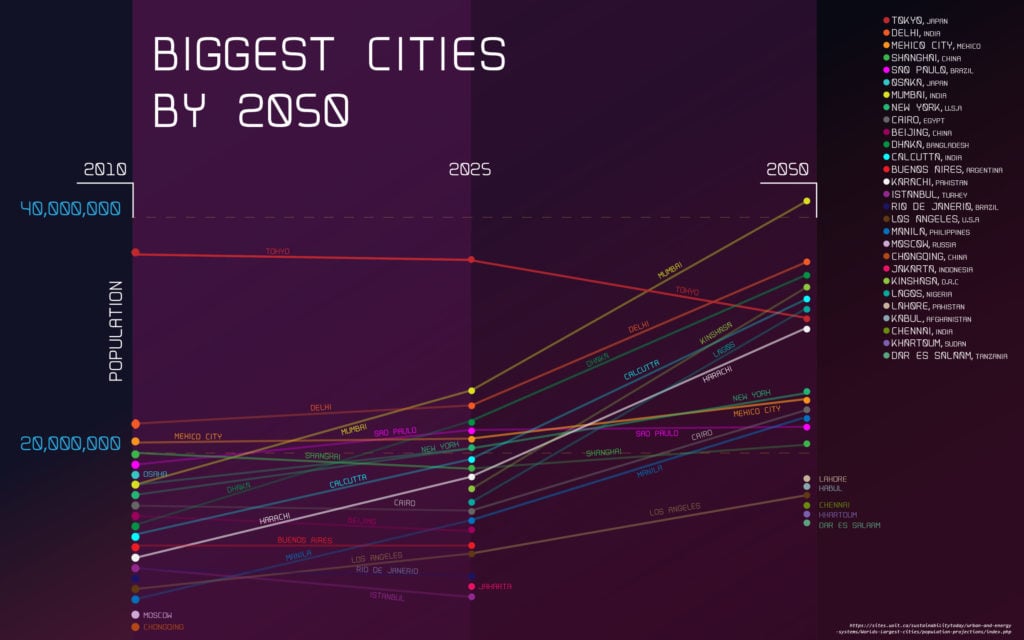
In 2010, Tokyo was the largest city in the world, with a population of 36 Million people.[7] That was nearly 15 million more than Delhi, in second place.
The rankings below and the projections further down come from a study by the Global Cities Institute at the University of Toronto, which was based on older UN data and city boundaries than the 2025 report. That is why the numbers don’t match the table above exactly. They are still a useful guide to which way each city is heading.
This was the study’s forecast for 2025, made before the UN’s new figures were published.
By 2050 the study expects rapid growth in African cities such as Lagos in Nigeria and Kinshasa in the Democratic Republic of the Congo.
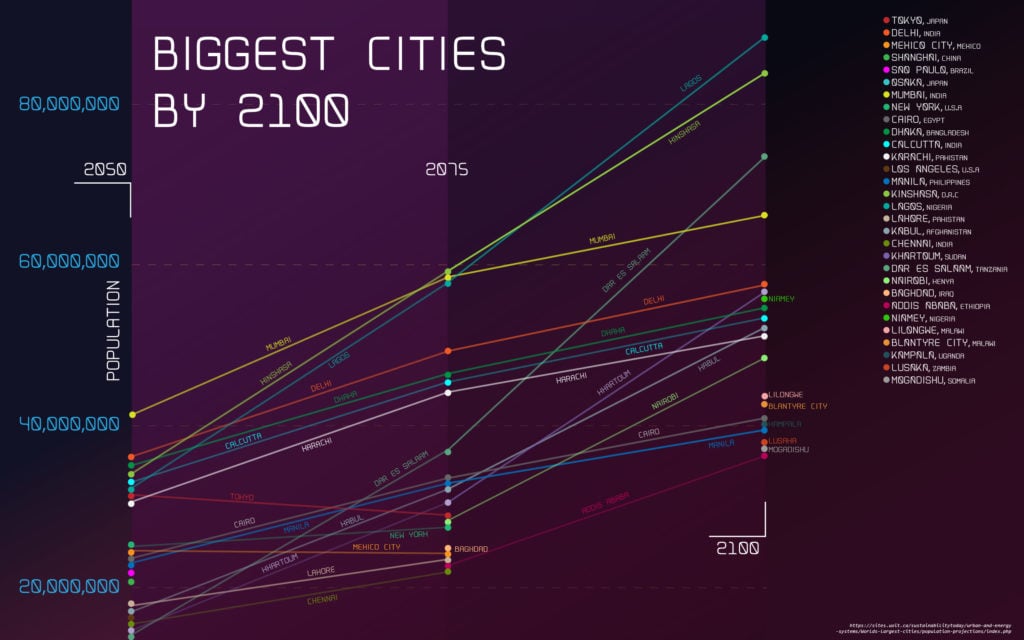
Projections this far ahead are uncertain, and the study’s own authors call for scepticism about the biggest numbers. Tokyo is not expected to be anywhere near the top 20 by 2100.
For comparison, these are the largest urban areas in the UK in 2021. All 14 together add up to about 26 million people, fewer than live in Jakarta or Dhaka alone.
A city of 40 or 80 million people needs clean water, sewers, power, transport, homes and flood defences on a scale that has never been built before. Civil and structural engineers design the bridges, tunnels and buildings. Transport engineers plan metro lines and roads that move millions of people a day. Water engineers find and treat enough drinking water and take waste away safely. Energy engineers keep the lights on, increasingly from renewable sources.
If you like the idea of shaping how cities work, read our guide to structural engineering careers in the UK, try the ICE’s city design challenge in the CityZen Award, or get a taste of running a city’s transport network with Transport for London’s virtual work experience.
Credit Infographic with thanks to Roof Stores
World Urbanization Prospects 2025
Jakarta (Indonesia) is now the world’s most populous city
Checked 23 November 2026
Jakarta Becomes the World’s Most Populous City, According to New UN Data
The 2025 edition introduces the Degree of Urbanization, a geospatial approach that applies consistent population and density thresholds
Checked 23 November 2026
Source: World Urbanization Prospects 2025, projections
Checked 23 November 2026
Today’s largest urban agglomeration is Jakarta, Indonesia, with 41.9 million residents, followed by Dhaka, Bangladesh (36.6 million), and Tokyo, Japan (33.4 million).
Checked 23 November 2026
This megacity has overtaken Tokyo to become the world’s largest city
Dhaka is expected to become the world's largest city by the middle of the century, per the U.N.
Checked 23 November 2026
World population projected to reach 9.8 billion in 2050, and 11.2 billion in 2100
The current world population of 7.6 billion is expected to reach 8.6 billion in 2030, 9.8 billion in 2050 and 11.2 billion in 2100, according to a new United Nations report being launched today.
Checked 14 October 2026
Currently, 757 million people reside in the 101 largest cities, with a population of 36 million for the largest city (Tokyo), and 3.5 million for the 101st largest city (Addis Ababa)
Working paper dated January 2014; later published in Environment and Urbanization (2017), doi:10.1177/0956247816663557.
Checked 14 October 2026
Projecting city growths typified by Lagos growing form 10.6 million in 2010 to 88.3 million in 2100 obviously call for a fulsome measure of skepticism; many variables could change.
Working paper dated January 2014. The article's 2025, 2050, 2075 and 2100 lists match Table 2 of this paper (101 largest cities with WUP extrapolations).
Checked 14 October 2026
Construction & InfrastructureInnovation
Construction & Infrastructure
Construction & Infrastructure
Construction & Infrastructure