Aerospace, Defence & Marine
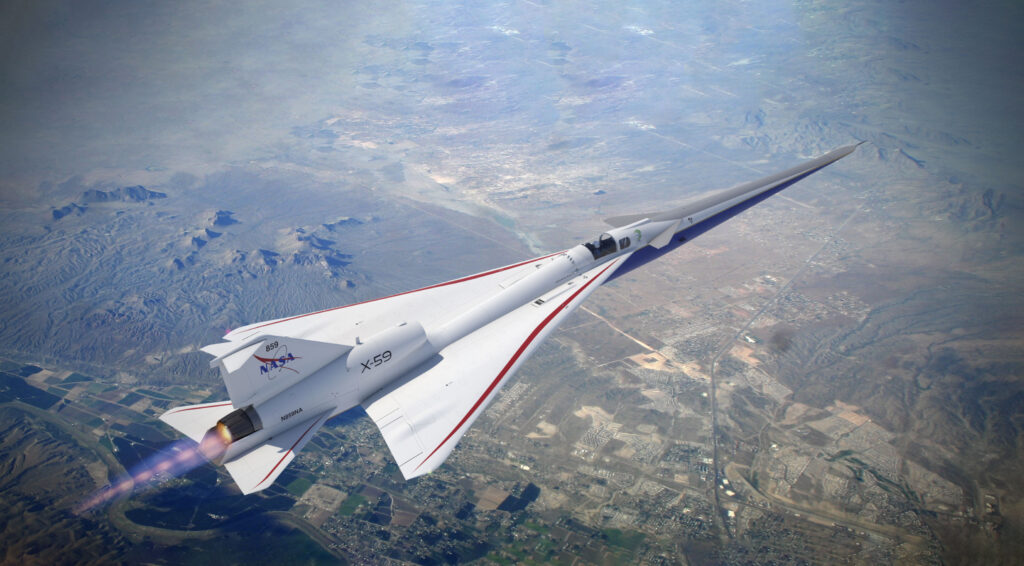
NASA has unveiled its X-59 quiet supersonic aircraft, designed to replace the sonic boom with a gentler thump and due to start test flights in 2024.
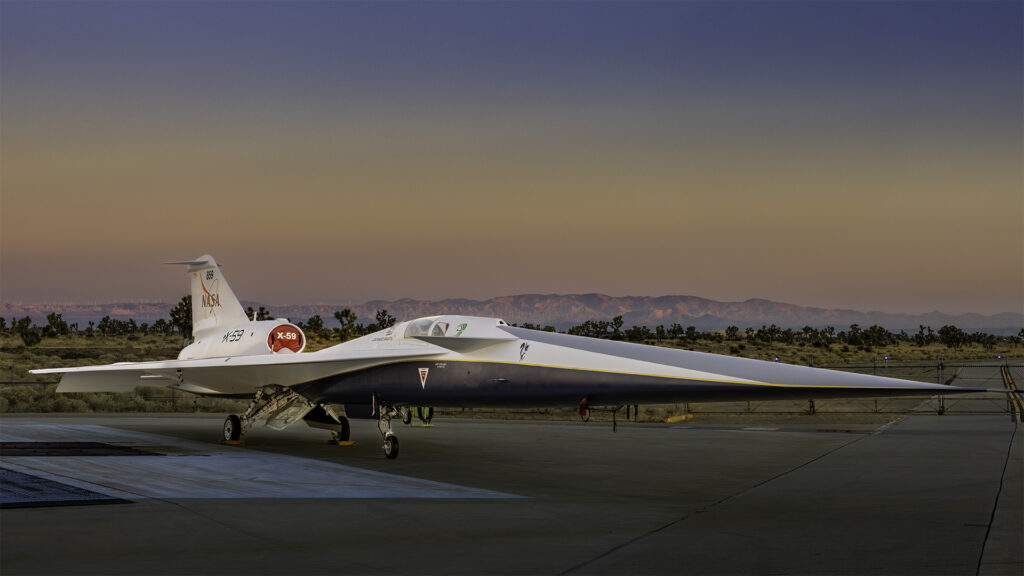
NASA has officially unveiled the prototype of its strikingly elongated X-59 aircraft. NASA’s Associate Administrator for Aeronautics, Bob Pearce, hailed it as a “nearly 100-foot step forward” toward quiet supersonic travel over populated areas.
Scheduled to start test flights in 2024[1][2], the US space agency hopes data gathered by the plane, nicknamed “Quesst,” will help convince aviation regulators that faster-than-sound commercial flight need not mean louder-than-thunder transit for communities on the ground.

The pursuit of new supersonic tech reflects the public’s fascination with extreme speed and frustration with current aviation limitations. Travellers once enthralled by iconic “Concordes” zipping luxuriously across oceans are today resigned to flying in conventional jets, no matter how far the destination.
Yet the economic and social barriers to enabling another leap in air transit velocity remain steep. When an aircraft punches through the sound barrier, tailored aerodynamics are required to manage the physics of dramatic drag increase and air pressure instability. Wave drag rises sharply in that critical transition between high subsonic and supersonic speeds. This increases fuel consumption even as sustainable technologies and policies nudge aviation toward decarbonization.
Sonic booms present further obstacles. The US Federal Aviation Administration prohibits civil aircraft from going supersonic, defined as Mach 1 or above, over land[3] due to intense disturbance from thunder-like nose pressure shocks. Rather than inspiration, the words “sonic boom” conjure costs in environmental impact assessments, damping dreams of fast transatlantic runs connecting New York and London.
Quesst’s engineering team claim its plane will demonstrate a greener way forward for speedier skies, pointedly marketing its “thump” as similar to a car door closing[4]. So how did NASA engineers behind this demonstrator aircraft tackle the economic and noise barriers to travelling at the sharpest edge of the sound barrier?
Quesst’s design represents years of NASA wind tunnel and simulation testing under its Commercial Supersonic Technology Project, with insights from Lockheed Martin’s parallel work for quiet supersonic prototypes.
The X-59 was built as NASA’s Low Boom Flight Demonstrator (LBFD)[5]. By sculpting aircraft contours to retain sonic shockwaves longer and prevent abrupt pressure rises, its shaping aims to mute thunder below the level of neighbour annoyance.
LBFD stands for “Low Boom Flight Demonstrator”, the NASA project name for the X-59, and the aircraft’s shaping is an engineering approach that aerospace engineers have developed to reduce the intensity of sonic booms.
The shaping works along the whole length of the aircraft:
By sculpting planes to retain these shockwaves for longer through all phases – initial impact, propagation over the length, and finally, the gradual release of pressure at the tail -this shaping provides an engineering means to minimize the loudness of sonic booms heard on the ground below.
The X-59 prototype applies this mitigation method further than past test planes, with additional adaptations all intended to make shock wave propagation smooth, stable and quiet.
Its 30-meter airframe[6] stretches this aerodynamic attenuation approach even further. Its highly elongated nose tapering gently to a narrow tip reduces initial air shock strength as the aircraft closes on Mach 1. The cockpit’s significantly aft positioning concentrates weight amidships, easing the sonic boom rise. Smoothed contours minimize drag while reducing the number of shock waves that could re-coalesce. Wing and stabilizer shaping prevent inadvertently magnifying remaining signature wave amplification.
NASA is designing the X-59 to produce a sonic thump of about 75 PLdB perceived loudness on the ground[7][8] at its planned cruise speed of 1.4 times the speed of sound, or 925 mph[9]. Data gathering test flights over communities after the aircraft’s flight testing will determine whether public reception confirms this laboratory analysis.
NASA’s Quesst effort remains focused on securing regulatory permission for commercial supersonic flight over land. The associated aviation rule change would remove longstanding barriers to sustainable speed in passenger and priority cargo markets.
For example, long flights connecting California and Sydney could be shortened substantially if future variants sustain supersonic speeds over continental routes. Similar time savings in national markets would recast concepts of distance, making once-remote locations more economically viable targets for manufacturing plants or company headquarters. NASA acknowledges supersonic transports must balance public benefit against any sustainability tipping point from increased frequency and range.
If Quesst delivers on critical metrics of greener power and gentler sonic footprint required for overland transit during upcoming test campaigns, exciting days may await upgraded successors to Concorde.
Credit via nasa.gov
NASA, Lockheed Martin Reveal X-59 Quiet Supersonic Aircraft
is set to take off for the first time later this year
Checked 25 October 2026
NASA Targets 2024 for First Flight of X-59 Experimental Aircraft
NASA's Quesst mission has adjusted the scheduled first flight of its X-59 quiet supersonic aircraft to 2024.
Checked 25 October 2026
FAA memorandum on civil supersonic flight over land
Since 1973, FAA regulations prohibit any civil, Mach I and greater, flight operations overland in the United States.
Checked 25 October 2026
Small Steps, Giant Leaps: Episode 67, Quiet Supersonic Mission
a sonic thump of 75 PLdB, which is like a car door closing down the street from your house
Checked 25 October 2026
About Low Boom Flight Demonstrator (LBFD)
LBFD is responsible for managing the construction of the X-59 Quiet Supersonic Technology (QueSST) experimental aircraft
Checked 25 October 2026
NASA, Lockheed Martin Reveal X-59 Quiet Supersonic Aircraft
At 99.7 feet long and 29.5 feet wide
Checked 25 October 2026
Small Steps, Giant Leaps: Episode 67, Quiet Supersonic Mission
a sonic thump of 75 PLdB
Checked 25 October 2026
How loud is X-59’s shaped sonic boom?
The target loudness for the X-59 is 75 dB on the Stevens Perceived Level (PL) scale.
Checked 25 October 2026
NASA, Lockheed Martin Reveal X-59 Quiet Supersonic Aircraft
is expected to fly at 1.4 times the speed of sound, or 925 mph
Checked 25 October 2026
Aerospace, Defence & Marine

Aerospace, Defence & Marine
Aerospace, Defence & Marine
Aerospace, Defence & MarineBreakthroughs