
Careers guides
How geography A level can prepare you for an engineering career
Geography allows you to study the physical world and how humans interact with it. While it’s technically a science, it also encompasses politics, economics…
What civil engineers do, pay and how to become one

Updated October 2026. All links and schemes verified against official sources.
Civil engineering is the branch of engineering that plans, designs, builds, and maintains the things a society runs on: roads, railways, bridges, tunnels, flood defences, water and sewage networks, airports, and energy sites. Civil engineers turn maths and physics into safe, long-lasting structures. In the UK, you can get in through a degree, a degree apprenticeship, a Level 3 technician apprenticeship, or a T Level, and graduates typically start on £26,000 to £35,000.
Every building, road, bridge, harbour, airport or energy facility relies on civil engineers. They determine how a structure will carry its loads, what the ground underneath can support, how water will flow around it, and how it can be built safely and on budget. A growing share of the work is about looking after what already exists: repairing ageing bridges, strengthening flood defences and making old infrastructure cope with a changing climate.

Photo by Frames For Your Heart on Unsplash
Civil engineering grew out of military engineering, and it is often called the second engineering profession. Its name marked out engineers who built for civilian life rather than for war. You will often hear it shortened to “civils”.
Civil engineers split broadly into two camps:
| Consulting (design) civil engineer | Contracting (site) civil engineer | |
|---|---|---|
| Main job | Designs schemes, runs calculations and models, writes reports and checks that designs meet regulations | Turns designs into reality on site: setting out, managing teams and subcontractors, quality, safety and programme |
| Where | Mostly office-based, with site visits | Much of the role is site-based; travel is common, and big infrastructure jobs can mean time away from home |
| Typical hours | 37 to 42 a week | 40 to 42 a week, with early starts or occasional weekends[1] when weather and deadlines demand |
| Typical employers | Design consultancies, local authorities, infrastructure owners | Civil engineering and construction contractors, specialist subcontractors |
A graduate civil engineer at a consultancy might start the day checking a colleague’s drainage calculations, spend the late morning in a design review with architects and a client, then build a 3D model of a retaining wall in the afternoon. A site engineer with a contractor might start at 7.30am with a safety briefing, set out the positions of new foundations using a survey instrument, check a concrete pour, and finish by updating the programme for the following week.
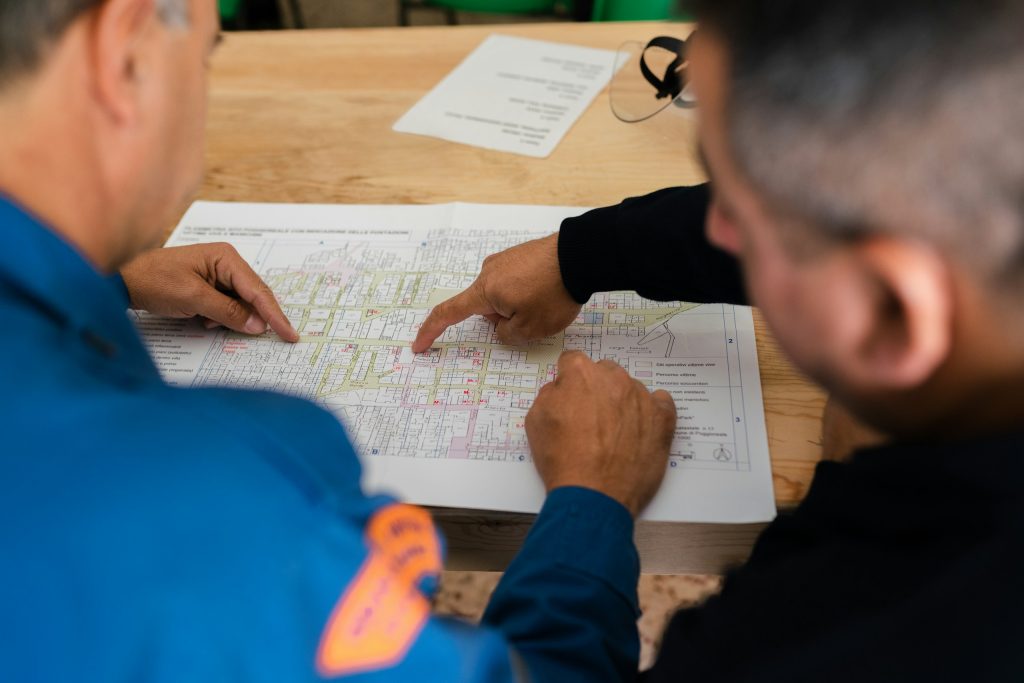
Photo by ThisisEngineering on Unsplash
Across both camps, the work usually includes:
Most jobs are advertised by specialism rather than as “civil engineer”. The main ones are:
| Specialism | What you would work on |
|---|---|
| Structural | Bridges, buildings, stadiums and towers: making sure they stand up and stay up |
| Geotechnical | Soil, rock and foundations; slopes, embankments and site investigations. Some employers favour a master’s in soil or rock mechanics |
| Highways and transport | Roads, junctions, transport assessments and road safety audits |
| Rail | Track, earthworks, drainage, stations and the interfaces with power and signalling |
| Tunnelling | Bored tunnels, shafts, caverns and underground stations |
| Water and wastewater | Clean drinking water, sewage treatment and drainage networks |
| Hydraulic, coastal and flood risk | Rivers, sea defences, dams and flood protection |
| Environmental | Contaminated land, waste, emissions and resource recovery |
| Energy and offshore | Offshore wind foundations, nuclear and power station civils, tidal energy |
| Aviation | Runways, taxiways and airport terminals |
| Career stage | Typical pay | Source |
|---|---|---|
| Apprentice (first year or under 19) | At least £8 an hour (national apprentice rate from April 2026)[2]; many civil engineering employers pay more | GOV.UK |
| Graduate, consulting | £26,000 to £35,000 | Prospects |
| Graduate, contracting | £27,500 to £33,000 | Prospects |
| Three to five years, consulting | £35,000 to £50,000 | Prospects |
| Three to seven years, contracting | £38,000 to £55,000 | Prospects |
| Senior, chartered or principal | £55,000 to £80,000 or more | Prospects |
| National Careers Service average range | £29,000 (starter) to £63,000 (experienced) | National Careers Service |
The National Careers Service offers a wider range, from £29,000 for starters to £63,000 for experienced civil engineers[3]. Salaries tend to be higher in London and the South East, although not every employer pays a separate London weighting[4]. For a wider comparison across disciplines, see our guide to engineering salaries in the UK.
| Stage | What helps | Notes |
|---|---|---|
| GCSE | Maths, science (ideally physics), English | 4 or 5 GCSEs at grades 9 to 4 are typical for a higher or degree apprenticeship[5] |
| A level (degree) | Maths is essential; physics is usually required | Manchester asks for AAA including maths and physics[6] for its BEng Civil Engineering (2027 entry) |
| Useful extras | Further maths, geography, geology, design and technology, computer science | Bristol counts geography as a science-related subject[7] for its civil engineering degree (2027 entry) |
| T Level | Design, Surveying and Planning for Construction, with the civil engineering specialism | Includes an industry placement of at least 315 hours (45 days)[8] |
Studying geography? Our guide to Geography Level and engineering shows how it links to civil engineering. Maths is the one subject you cannot skip: see how A-level maths prepares you for engineering.
| Route | Level | How long | Entry | Where it leads |
|---|---|---|---|---|
| Degree (BEng or MEng) | 6 or 7 | 3 to 4 years full time (4 to 5 in Scotland) | A levels or equivalent including maths, usually physics | Graduate engineer; MEng is the most direct path to Chartered Engineer (CEng) |
| Civil engineering degree apprenticeship | 6 | Typically 60 months | Usually three A levels including maths and a physical science | Accredited BEng or BSc, earning a salary, no tuition fees |
| Civil engineering technician apprenticeship | 3 | Typically 36 months | Usually 5 GCSEs at grades 9 to 4, including English, maths and science | Technician roles and Engineering Technician (EngTech) registration; can progress to a degree apprenticeship |
| T Level in Design, Surveying and Planning for Construction | 3 | 2 years | GCSEs, set by the college | Apprenticeship, job or university (Distinction* = 168 UCAS points)[9] |
| Foundation apprenticeship (onsite trades) | 2 | Typically 8 months | Ages 16 to 21 | A first step into construction, then a Level 2 or 3 apprenticeship |
A note on BTECs: funding approval for Pearson’s BTEC National Diploma and Extended Diploma in Civil Engineering in England ended on 31 July 2025[10], so check what your college now offers. The T Level above is the main Level 3 classroom route in England.
Not sure whether to go to university or earn while you learn? Read engineering degrees vs degree apprenticeships and a week in the life of a degree apprentice and an engineering student.
The Institution of Civil Engineers (ICE) is the professional body for civil engineers in the UK. Through it, you can register with the Engineering Council as:
The Engineering Council’s national register holds more than 228,000 engineers and technicians across all disciplines[11]. The Chartered Institution of Highways and Transportation (CIHT) and the Institution of Structural Engineers (IStructE) are also relevant for some specialisms.
Civil engineers work for:
Costain, Kier, Laing O’Rourke, Mott MacDonald and WSP have all sponsored ICE QUEST undergraduate scholars, who receive paid summer placements.
More options are in our engineering scholarships and engineering competitions guides.
Yes. CITB’s Construction Workforce Outlook says an average of 41,200 extra workers will be needed each year between 2026 and 2030[16][17], around 206,000 over the five years. Rail, roads, flood defences, water and clean energy all need civil engineers to design and deliver them.
Years 9 to 11
Years 12 and 13
After school or college

Photo by ThisisEngineering on Unsplash
It is designing, building and maintaining the structures and systems everyday life depends on, such as roads, railways, bridges, tunnels, water supply, sewers and flood defences.
The core subjects are structures (how things carry loads), materials (concrete, steel, timber), geotechnics (soil and rock), hydraulics (how water moves), surveying and project management, all built on maths and physics.
Design engineers spend most of their time on calculations, models, drawings and meetings, with site visits. Site engineers set out works, supervise teams and check quality and safety on site.
Graduates typically start on £26,000 to £35,000.[18] With three to seven years’ experience, £35,000 to £55,000 is typical[19][20], and senior or chartered engineers can earn £55,000 to £80,000 or more[21][22].
Yes. A Level 3 civil engineering technician apprenticeship gets you working without A levels, and a Level 6 degree apprenticeship gives you an accredited degree[23] while you are paid, with no tuition fees.
19 October 2026
Every figure above is footnoted to its source, each checked between 14 and 19 October 2026.
Feedback or corrections? Email [email protected].
Becoming a contracting civil engineer | Salary, skills, requirements
You'll usually work 40 to 42 hours a week, but site deadlines, weather conditions, deliveries and safety requirements can mean early starts, late finishes or occasional weekend work.
Checked 14 October 2026
National Minimum Wage and National Living Wage rates
An apprentice aged 21 in the first year of their apprenticeship is entitled to a minimum hourly rate of £8.
Checked 15 October 2026
Average salary (a year) £29,000 Starter to £63,000 Experienced
Checked 19 October 2026
How to become a consulting civil engineer | Salary, skills, requirements
Salaries tend to be higher in London and the South East, although not every employer pays a separate London weighting.
Checked 15 October 2026
4 or 5 GCSEs at grades 9 to 4 (A* to C) and A levels, or equivalent, for a higher or degree apprenticeship
Checked 19 October 2026
BEng Civil Engineering (2027 entry)
A-level AAA including Mathematics, Physics, and one other subject
Checked 14 October 2026
BEng Civil Engineering (2027 entry)
A-level standard offer A*AA including A*A (in any order) in Mathematics and a science-related subject. Science-related subjects include: Biology; Chemistry; Computer Science; Further Mathematics; Geography; Geology; Physics; Electronics; and Design & Technology
Checked 14 October 2026
T Level in Design, Surveying and Planning for Construction
industry placement runs for a minimum of 315 hours (45 days) overall
Checked 19 October 2026
How do T Levels work with UCAS points?
the same number of points as 3 A*s at A level
Checked 19 October 2026
BTEC Nationals Construction and the Built Environment (2017)
Title: Pearson BTEC Level 3 National Extended Diploma in Civil Engineering Qualification number: 603/1216/6 Guided learning hours: 1080 ... Eligible for funding (England): Funding approval end date - 31/07/2025
Checked 15 October 2026
FAQs: Professional registration
We hold the national register of over 228,000
Checked 19 October 2026
Applications are now open until the deadline of 13 November 2026.
Checked 19 October 2026
QUEST Undergraduate Scholarship
predicted A-level grades of ABB or higher
Checked 19 October 2026
QUEST Undergraduate Scholarship
Applications are now closed and will reopen in March 2027.
Checked 19 October 2026
The ICE CityZen Award challenges students aged 16-18 to become virtual civil engineers and design bold, inclusive, and sustainable solutions for the communities of tomorrow. The competition is in two parts – the four-round CityZen Award computer game and an optional project.
ice.org.uk blocks automated requests; text checked on the Wayback Machine copy of 21 July 2026. The page also says: "This shorter ICE CityZen challenge invites students aged 14-16".
Checked 14 October 2026
Construction Workforce Outlook 2026-2030
An average of 41,200 extra workers will be needed each year between 2026 and 2030.
Checked 19 October 2026
Construction must find 206,000 extra workers by 2030, says CITB
an extra 41,200 worker needed annually
Checked 19 October 2026
How to become a consulting civil engineer | Salary, skills, requirements
Graduate consulting civil engineers typically earn £26,000 to £35,000.
Checked 14 October 2026
Becoming a contracting civil engineer
With around three to seven years' experience, salaries commonly rise to £38,000 to £55,000.
Checked 19 October 2026
How to become a consulting civil engineer
With around three to five years' experience, salaries are usually £35,000 to £50,000.
Checked 19 October 2026
How to become a consulting civil engineer | Salary, skills, requirements
With around three to five years' experience, salaries are usually £35,000 to £50,000. Senior, chartered or principal consulting civil engineers can earn £55,000 to £80,000 or more, while engineering directors may earn considerably higher salaries.
Checked 15 October 2026
Becoming a contracting civil engineer
Senior chartered or specialist civil engineers can earn around £55,000 to £80,000
Checked 19 October 2026
Successful apprentices will gain a BSc or BEng civil engineering degree which is accredited by the Joint Board of Moderators
Checked 19 October 2026
Typical duration 60 months
Checked 19 October 2026
Civil engineering technician (ST0091 v1.1)
Typical duration: 36 months (this does not include assessment period)
Checked 19 October 2026
Onsite trades foundation apprenticeship
The apprentice must normally be age 16 to 21 at the start of their apprenticeship.
Checked 19 October 2026
Last checked 19 October 2026 by the Born to Engineer editorial team
If you have any feedback, spot any errors or have suggestion on how we can improve our resources please let us know at [email protected]
Careers guides
Geography allows you to study the physical world and how humans interact with it. While it’s technically a science, it also encompasses politics, economics…

Careers guides
Are you interested in automation, robotics, cars or even medical engineering? A career in mechanical engineering (M.E.) will open up a huge number of…

For studentsReal engineer
Milly Hennayake is a civil engineer. She studied civil engineering at the University of Cambridge, and first got involved with Engineers Without Borders UK…

For studentsCareers guides
If you’re applying to study engineering at university, then you’ll know that there are a lot of degrees courses out there, covering a broad…

Construction & Infrastructure

Construction & Infrastructure
Construction & Infrastructure