Energy & EnvironmentBreakthroughs
University of Zurich astrophysicists have used the Piz Daint supercomputer to simulate 25 billion virtual galaxies from 2 trillion particles. The catalogue will help calibrate the Euclid satellite's hunt for dark matter and dark energy.
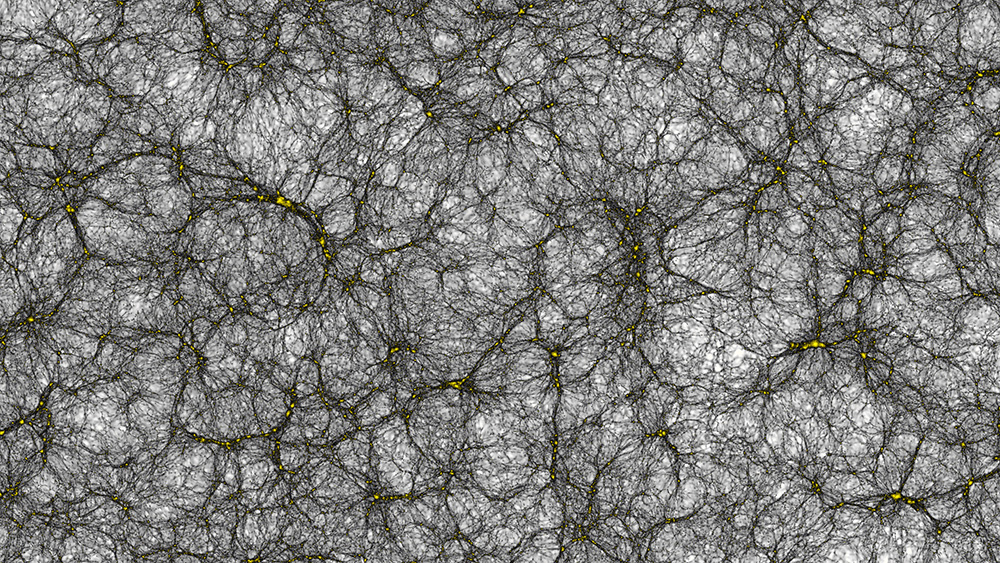
Researchers from the University of Zurich have simulated the formation of our entire Universe on a supercomputer.
This section of virtual universe – a billion light years across – shows how dark matter is distributed in space. Dark matter halos are the yellow clumps
The computer model was able to generate a gigantic catalogue of 25 billion virtual galaxies made up from 2 trillion digital particles[1][2].
The team from the University of Zurich want to use this catalogue to calibrate the experiments on board the Euclid satellite – it will be launched in 2020[3] and aims to investigate the nature of dark matter and dark energy.
The model was created over three years[4] by a group of astrophysicists from the University of Zurich. The team had to develop and optimise their code to describe the dynamics of dark matter and the formation of large-scale structures in the Universe.
They called their code PKDGRAV3 and optimised it to use all the available memory and processing power of a modern supercomputer.
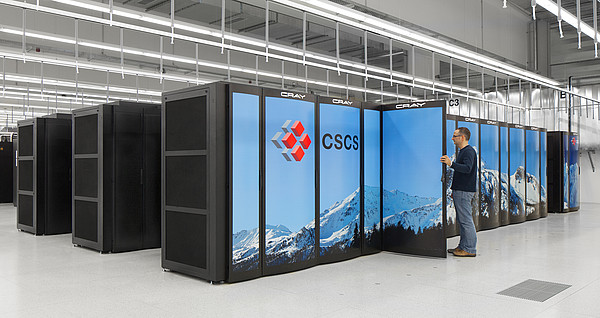
The calculation was executed on the “Piz Daint” supercomputer of the Swiss National Computing Center (pictured above) and took 80 hours to generate the virtual universe of two trillion macro-particles[5][6].
The nature of dark energy remains one of the main unsolved puzzles in modern science. Romain Teyssier, UZH professor for computational astrophysics
The experiment is designed to allow researchers to better understand Dark Matter. Currently, it is believed that our cosmos consists of 23 percent of dark matter and 72 percent of dark energy[7].
The new dataset will be used to calibrate the experiments on board the Euclid satellite.
Euclid will capture the light of billions of galaxies in large areas of the sky – allowing for scientists to measure the subtle distortions around galaxies that are believed to be caused by dark matter.
Euclid will perform a tomographic map of our Universe, tracing back in time more than 10-billion-year of evolution in the cosmos. Joachim Stadel from the Institute for Computational Science of the UZH
The model should allow engineers working on Euclid to better plan an observational strategy and minimise errors before the satellite embarks on its six-year data collecting mission in 2020[8].
The paper “PKDGRAV3: beyond trillion particle cosmological simulations for the next era of galaxy surveys” was published by Douglas Potter, Joachim Stadel, Romain Teyssier in Computational Astrophysics and Cosmology, 2017; 4
Credit via media.uzh.ch
The Largest Virtual Universe Ever Simulated
A gigantic catalogue of about 25 billion virtual galaxies has been generated from 2 trillion digital particles.
Checked 9 November 2026
PKDGRAV3: beyond trillion particle cosmological simulations for the next era of galaxy surveys
We report on the successful completion of a 2 trillion particle cosmological simulation to z=0 run on the Piz Daint supercomputer (CSCS, Switzerland),
Checked 9 November 2026
The Largest Virtual Universe Ever Simulated
the Euclid satellite, that will be launched in 2020
Checked 9 November 2026
The Largest Virtual Universe Ever Simulated
Over a period of three years, a group of astrophysicists from the University of Zurich has developed
Checked 9 November 2026
The Largest Virtual Universe Ever Simulated
The code was executed on this world-leading machine for only 80 hours
Checked 9 November 2026
PKDGRAV3: beyond trillion particle cosmological simulations for the next era of galaxy surveys
using 4000+ GPU nodes for a little less than 80 h of wall-clock time or 350,000 node hours.
Checked 9 November 2026
The Largest Virtual Universe Ever Simulated
The cosmos consists of 23 percent of dark matter and 72 percent of dark energy.
Checked 9 November 2026
The Largest Virtual Universe Ever Simulated
before the satellite embarks on its six-year data collecting mission in 2020.
Checked 9 November 2026
Energy & EnvironmentBreakthroughs

Electronics & Communications

Electronics & Communications

Electronics & Communications